Skip to content
  • Home
  • News
    • Sports
    • Arts
    • Toronto
    • Ontario
    • Canada
    • Hemingways
  • Events
  • About
    • Contact Us
    • Business Directory
    • Kia Ora Canada – Toronto
    • The Board
    • Sponsors
    • Past Supporters
  • Newcomers
    • Guides
Menu
Kia Ora Canada
  • Home
  • News
    • Sports
    • Arts
    • Toronto
    • Ontario
    • Canada
    • Hemingways
  • Events
  • About
    • Contact Us
    • Business Directory
    • Kia Ora Canada – Toronto
    • The Board
    • Sponsors
    • Past Supporters
  • Newcomers
    • Guides
Hit enter to search or esc to close
Joseph Simpson
7 Articles
Posted inCanada Home News Sports

All Blacks fall short in Greatest Rivalry equaliser

Featured Image: The Atmosphere at M&T Bank Stadium – Joseph Simpson

Baltimore, Maryland, U.S.A. Best known to the outside world for the 1988 and 2007 films of the same name ‘Hairspray,’ Edgar Allan Poe’s brief residence, and not a great deal else unless you are a fan of Major League Baseball (MLB) or the National Football League (NFL). The city flew under the radar during the FIFA World Cup earlier this year, despite the 71,000 capacity dwarfing several other stadiums used in the competition. Overall, Baltimore does not make global, or national headlines very often. On Saturday, international headlines were certainly made, as for the first time thirty years, a victor was declared in a All Blacks-Springbok tour.

Before Baltimore

Fans heading to the stadium – Joseph Simpson

The Greatest Rivalry tour had been a difficult watch for Kiwis around the world. The All Blacks started very strong. This siad, the first five games opened with far from gauranteed results. Given the lynch mob that is the New Zealand public, and recently, the New Zealand Rugby executive, and the extended history of not losing (almost!) every game to non-test sides, anything other than a four-from-four sweep of the provincial teams would have likely led to Scott Robertson or Jamie Joseph getting on a flight to South Africa.

One of the main differences discussed in the media is the difference in depth between the two international sides, with the Springboks largely considered to have talent running much further deep than the All Blacks. This is not because of raw talent, as New Zealand has plenty of that, but how the caps have been shared amongst the Springboks differs greatly from the All Blacks. On-form players can be dropped and benched in Rassie Erasmus’ squad without complaint, compared to the All Blacks, whom under Rennie, Robertson, Foster, and beyond, aging players will be given the nod over younger talent almost every time since the game became professional back in 1996, when the All Blacks fatefully exacted their revenge on the Springboks for the 1995 World Cup defeat. It really makes you wonder, have we really learnt nothing from the ‘New Zealand Cavaliers’ and the ‘Baby Blacks’?

With this being said, with ten debutants only halfway through the test calendar, Rennie is certainly more comfortable with giving Black Jerseys to probables and possibles, even if it is to soak up the hurt from Western Province farm boys or Gqeberha (Formerly Port Elizabeth) battlers. Seeing the likes of Ruben Love and Cam Roigard hold onto the inside back jersey for most of the tour shows that the All Blacks are flirting with the idea of returning to a true meritocracy.

It’s a shame that these descisions possibly came too little too late for the men in black. Opening the tour in the fortress of Ellis Park, Johannesburg, the All Blacks took advantage of every loose ball opportunity, every penalty, every poorly formed ruck, to run circles around Pieter-Steph du Toit’s Springboks, winning a comfortable 33 to 16. Josh Moorby gave everyone glimpses of everyone’s favourite express, Paekākāriki’s Christian Cullen with his movement on attack. Fabian Holland might not have saved the scrum but certainly played out of his skin in the lineout and had a defensive workrate of Brodie Retallick, while Love and Roigard looked as composed as they did in their rampaging Super Rugby championship earlier in the year. It’s safe to say the All Blacks do in fact, have an admirable starting 23.

After Ellis Park, everything seemed to go wrong. There are the obvious we can talk about, injuries plagued the All Blacks, with several starters going in exchange for the loss of South Africa’s Cheslin Koble. The scrum was incredibly poor in the first test, slightly remedied by very vigilant officiating in the second test, but never fully recovered for the return to Johannesburg (If you aren’t cheating you aren’t trying – Al Davis). Coaching could be worth mentioning, but the attack and defence of both teams largely did not change from test to test. Kurt-Lee Arendse, who we will mention a lot more in this article, pulled off something that could not have been expected, like Caleb Clarke‘s debut in 2020, or Louis Bielle-Biarrey deciding to put France on his back any time they’re down a try. The Springboks loved their scrum and their maul, but were pretty useless outside of that. The All Blacks only succeded in grinding down the Springboks with extended phases once in all of four tests. The Stregnths and weaknesses of both sides were on full display.

Then comes Baltimore. The staging ground for All Black redemption, currently down two to one to their greatest rivals. While this is the first ever international rugby match held at M&T Bank Stadium, both sides have had disappointing experiences less than an hours drive away, in the national capital of Washington D.C. In Rassie Erasmus’ first-ever test, the Springboks fell short against Wales 22-20, a team that would then go on to have a 4-0 winning streak against the South Africa, broken only in their fateful 2019 Rugby World Cup Clash. The All Blacks visited D.C in 2021 to take on the U.S.A Eagles in a game that the Americans will remember for their first ever tries against the All Blacks, in exchange for a 104 point thumping, but for the All Blacks it was without competition and without a crowd, with well over a third of the stadium visibly empty for the clash. The biggest rugby brand in the world, in the capital of biggest market in the world, and everyone stayed home!

While D.C might already be written off for the men’s and women’s Rugby World Cups, Baltimore clearly isn’t. The city, and both teams, had a lot to prove. So it makes you wonder why Beauden Barrett, Rieko Ioane, Richie Mo’unga, and Patrick Tuipulotu got the nod over the All Blacks of tomorrow for this test? Perhaps it was verancy that Dave Rennie wanted, a change of pace in the game? Perhaps it was in response to the Springboks naming a veteran squad? Cynically, you could ask yourself whether the U.S. stakeholders demanded more recogniseable games for this game? That seems like an absurd theory, but the addition of these players felt like an NBA All Star game, and arguably, many of them played like it was one too.

The Match

M&T Stadium just before the Star Spangled Banner – Joseph Simpson

After a rendition of the Star Spangled Banner, which the ground announcer forgot was supposed to take place, the Springboks and All Blacks Arrived on the field to sing God Defend New Zealand followed by Nkosi Sikelel’ iAfrika. Captain Codie Taylor was joined by golfer and major championship winner Ryan Fox as the flag bearer, a slightly more recogniseable face for the American fans to legends Sean Fitzpatrick and Ruahei Demant. Followed by a return to Kapa o Pango led also by Taylor. Unlike in South Africa where Rassie was fighting a loosing battle to quiet the crowd. There was a surprising hush amongst the stands as the All Blacks performed, especially considering out of the almost seventy thousand spectators present, at least fifty would have been wearing the green and gold.

It’s worth noting that the atmosphere in Baltimore before the game was the eeriest I’ve ever experienced for a rugby game, especially for a New Zealand – South Africa game. I was expecting rambunctious pubs, cheers and quips in the street, photos and jersey swaps. While there certainly was enough of green and gold, and black and white, to make the Baltimore waterfront look like Auckland’s Viaduct Harbour and Wynyard Quarter, you’d think you’d just shown up to sip some bubbly at the ASB Classic. Perhaps several of the South Africans, who must go through a visa process, were intentionally on their best behaviour. Or for the rest of them, including a large portion of New Zealand supporters, were Americans picking national sides to get behind like we do back home with our NBA teams. Does anyone else back the Oklahoma City Thunder solely because of Steven Adams’ drafting? Say what you will about the U.S.A, public drunkeness outside of a university is much harder to come by than it is in the southern hemisphere.

It certainly wasn’t going to be easy to get written off at the game with the average alcoholic beverage setting you back $20 USD after tax and tip (about 35 NZD, or 350 Rand for those at home), nobody will be complaining about the prices at Eden or Ellis Park after this match. Even if you were thirsty, you’d spend most of your time in line as North American sports fans are not ones to wait till half time for their hotdog and Budweisers. Due to the significant number and legnth of stoppages in sport here, you better believe that the concession stands are always busy, and they’ll follow this even when the rest of the world is in town. Scrum? Bathroom break. Lineout? Popcorn. Conversion? Selfies in front of the Baltimore Ravens’ stadium installations.

Quiet atmospehre aside, the match must go on. Richie Mo’unga, who hasn’t played a test since the 2023 World Cup Final, kicked off everything in Maryland. The Springboks took first blood with a penalty through the boot of Sacha Feinberg-Mngomezulu which was quickly responded to by a break from Will Jordan and Damian McKenzie charging into the Boks twenty-two after after a few failed attempts to find space on the edges. Roigard picking the right man as skipper Codie Taylor crashed over the line about ten metres in from touch.

Springbok tries after this were frustratingly predictable, and even worse, inevitable. It would seem that the All Blacks defence on the try line is not up the the physicality that the Springboks will put in, not just on individual touches and tackles, but every single ruck. When an All Black was taken to ground in Baltimore, the Springbok tackler would always roll and then jackal for the ball, nearly every single time, forward, or back. If it’s contested? Let the All Blacks have it. The reason this worked is because there was no visible structure to the All Black attack, or perhaps the organised chaos of a knock on or loose ball was the structure. The problem with this is often outside backs found themselves in narrowing space without any support runners, forcing them to either make an ambitous pass or concede a penalty holding onto the ball after they get flattened by a cake-munching baby rhinoceros.

This is something we see consistently from All Black loose forwards but only occasionally will the likes of Cam Roigard or Will Jordan bother to attempt to turn over the ball in the ruck. But it’s also a lot harder to do because of how the Springboks attacked, their structure was very tight, there were guards at every rucks and only on a few occasions did the magic feet of Kurt-Lee Arendse turn tactics off and have a go himself, often supported by several midfielders or outside backs. Rassie simply had the All Black attack figured out, and knew they didn’t have the physicality to mount a solid defence.

Damian de Allende socred right under the noses Ethan de Groot and Anton Lienert-Brown, possibly because most of the forward pack were worried about Eben Etzebeth’s carry two phases before hand and hadn’t got to their feet, and eventual player of the match Morné van den Berg ‘broke’ Sam Darry’s ankles after another All Black overcommitment to the driving maul. But was it an overcommitment?

Its worth noting here that a continously exploited and criminally simple tactic from Rassie in earlier tests was simply to take the ball from edge to edge to put defensive weak points Leroy Carter and Damian McKenzie in the same channel. This was such a problem that Jesse Kriel, arguably one of the least powerful bodies in the Springbok arsenal, looked like 1995 Jonah Lomu on the wing, smashing through defenders, when he wasn’t spilling the ball, that is. Come Baltimore, this was no longer a problem with Josh Moorby given the nod over Carter, but where Jessie Kriel might have had a slgihtly quieter game, accross the board the aging Springbok squad (the average age on the team was 31 for this test) were either too strong, or too fast, for the equally aging All Blacks.

Funnily enough, for all the attacking errors and inability to defend the All Blacks found themselves in, one of the best tries came right after this with a thirty-phase monster toward the end of the first half which some might argue was the All Blacks having nothing on for attack. I’d argue it’s the first and only time in eighty minutes the Kiwis matched Springbok physicality. After bunching in the Bok defenders on the right-hand-side, a simple, but perfectly executed series of passes from New Zealand’s playmakers allowed for Will Jordan to find a gap and score under the posts, not without having to muscle through Damian de Allende to get there. So the All Blacks do have the pace and physicality to match the springboks, they are able to run a structured attack. It’s just a shame for the series it felt like they did that for 32 phases in Baltimore and one game in Johannesburg and nowhere else.

Half time: South Africa 17 – 14 New Zealand.

Malcolm Marx through the maul, Pieter-Steph du Toit muscling straight over the edge of a ruck with no guards, the first two score of the second half were the exact same as the first. Instead of veteran Anton Lienert-Brown been caught dozing, Reiko Ioane had a turn staring at both his midfielders in green joining the maul, guarding against a nine already covered by Cam Roigard. This said, two score down, the All Blacks are never out of a game.

Once again, the All Blacks continually run like a bat out of hell the moment the ball spills forward into their hands, and they continually concede a turnover for having no support runners. For most of the second half this was the reoccuring theme in the All Black attack. The moments where the All Blacks looked at their best was when the loose forwards would lead the charge. Perhaps with Ardie Savea out for the test, and the daunting task of matching the inspirational Siya Kolisi, or the physical Pieter-Steph, kept most of the loose forwards out of making big breaks. They spent most of the game sticking to the dog work in the breakdown to make up for the sluggish workrate of Sam Darry and Patrick Tuipulotu who on more than one occasion got blown over or penalised for poorly judged ruck entry. Wallace Sititi, Peter Lakai and Ethan Blackadder all contributed heavily to pinning excess Springbok forwards to provide Blackadder the opportunity to score, and it was one of the only moments we got to see them on the front foot for the whole game.

And then at the 70th minute, eight points down, Damien McKenzie is put into beautiful space thanks to Tupou Vaa’i, there is thirty metres of open space as the entire forward pack of both teams has crumpled together just past New Zealand’s 40 metre mark. Moorby runs in support on the DMac’s left, Jordan to the right. Manie Libbok closes the space in less than a second. Libbock puts his left shoulder into Damian but before he can Damian dummys to Moorby, is he going to pass it right to Will Jordan? Arendse has twisted his body away from Will Jordan, the fastest player on the field. He’s taken the bait of the dummy.

No, Damian still makes the pass, even after he must see Cameron Hanekom breaking Josh Moorby’s two metres of covid social distancing, the same Cameron Hanekom who up until this point had tackled two players off the ball this game so far and was clearly very comfortable going for it a third time. Hanekom’s arms are wrapped around Moorby before Moorby catches the ball, Will Jordan puts his arms up in total hysteria. The error Kurt-Lee Arendse made has now become an advantage, the ball spills straight into his hands and Moorby who is once again without a single support runner is powerless to do anything. Vaa’i doesnt even bother to shift his body weight in the way, whether that’s because of laziness, or the sheer feeling of defeat he must of been feeling, it didn’t change the fact that it left Arendse with 40 metres of space between him and the try line and the only people around to stop him were the exhausted Lakai and Blackadder. 71 minutes in the score sits 36-21 to the Springboks.

If Ardie was the rallying cry for the All Blacks in the first test, just like the French knights in the battle of Agincourt, Kurt-Lee Arendse was the English and Welsh longbowmen that snuffed it out like a flame. Cameron Hanekom was handed the easiest score in All Black Springbok history as the All Blacks decide defending rucks just aren’t worth their time. Shortly after, for the 2019 World Cup strategy’s sake, Richie Mo’unga slots a pass so the veteran Beauden Barret who puts on his afterburners to sneak a consolation prize under the posts.

Full time: South Africa 43 – 28 New Zealand.

The two giants of rugby joined together in prayer, before presenting the Rugby’s Greatest Rivalry trophy to the deserving champions, South Africa.

After the Match

Richie Mo’unga after the game – Joseph Simpson

Naturally, the questions that came in from journalists when Rassie and Siya arrived in the press conference were simple. In typical fashion of the South African media, much was to be said about the legacy of the Springboks. Can they comfortably call themselves better than the All Blacks? Is this the greatest team of all time? Would the 2019-2026 Springboks beat the 2011-2015 All Blacks? In truth, there’s a real argument for all of these quite silly questions. Sure, every game hung in the balance, sure, the Springboks played a hard to beat, but still very beatable, brand of rugby, sure, they lost the first test at their home fortress, but seated underneath the Baltimore Ravens’ stadium, the All Blacks had lost thress games in a row to them.

This is where the humility of Rassie and Siya shone. Rassie Erasmus humbly described the margin between South Africa and New Zealand by holding his fingers up to journalists about one centimetre apart.

“At minute sixty I still thought it was in the balance” Rassie said, later acknowleded Kurt-Lee Arendse‘s opportune thinking and score was the main moment that tipped the scales out of New Zealand’s reach.

Out of the record crowd, which stood at 68,173, the largest ever in the U.S.A, you would have called it a South Africa home game.

“It’s awesome to go all over the world, we have a massive country, a whole lot of people, and some people (supporting) from other countries.” Rassie said.

In his first test as head coach, the aforementinoed loss to Wales in Washington D.C, he didn’t get a great opportunity to see the country. This time around, he and the coaching staff took some time to visit the surrounding areas, including New York City.

Rassie and Siya stoked with the performance – Joseph Simpson

“I like the country, I didn’t know there was so many South Africans (here)!.

Commenting on the redemption for the bitter loss in his first game, he continued, “Obviously that first time (versus Wales) was awful, – a couple of years later, we win against a great team here like New Zealand, it makes up in a big way for that start I had.”

Both dedicated the victory to the fans and country of South Africa, those abroad and back home, and those who could afford to come and those who couldn’t. The ticket pricing of the tour, not only in Baltimore but also in South Africa, especially for the tests against the United Rugby Championship Sides, has been a particularly sour note in South African media. It will be interesting to see what ticket pricing will look like when they come to New Zealand in 2030.

Upon the arrival of Dave Rennie and the battered and bruised Codie Taylor, the New Zealand journalists droned on in their typical fashion, with the most insightful questions typically revolving around officiating, injuries, penalties, and what can be done differently.

One of the few moments of relief from the slog was surprising the American media, who asked particularly good questions about the games impact on the U.S market, the attendance record, how both teams were enjoying North America, and naturally hinting at the possibility that several of the players and coaches could be meeting again in the 2031 world cup in America. Having this third party of no-fuss professionals was excactly what the tour needed to avoid the repeating the exact same questions that took place after the tests in South Africa.

On the topic of playing in the United States, Codie said, “It’s been amazing to come to come over here and soak up what America has to offer – they obviosly love their sports and have got right behind rugby.”

The atmosphere with Rennie and Taylor was very somber and direct – Joseph Simpson

Rassie Erasmus wasn’t the only person susprised by the large presence of South Africans in the country. Codie continued, “I would have liked to see more black jersey’s but obviously there’s more South African’s over here which I wasn’t aware of until I kept seeing them up and down the hotel elevator!”

Not only did Codie Taylor acknowledge the great experience they had in the United States, but also the hope that they will capitalise on the interest in the sport.

“(We hope American’s see) how exciting rugby can be, America’s got some great sports over here and they’re fanatical about everything they’re involved in. It would be great to see U.S.A Rugby keep building, – Leading into 2031, it’s in a great place to build a foundation on what will be an awesome world cup”

Speaking of the World Cup, if Baltimore were hoping to build a case to host, M&T Stadium and the events building up to this game have made an incredibly strong argument. Despite Egar Allan Poe and Hairspray being the city’s international reputation, there’s so much more to this great place. It certainly does not have Chicago or New York’s infrastrucutre, but it brought the fans and the atmosphere. There will probably have to be significant investment from World Rugby or U.S.A Rugby to make it happen, but it’s better than a half-filled stadium in Washington D.C. Read more about Six60 and the programming in Baltimore here.

Lastly, a Canadian perspective on the game. Canada’s mens rugby team have been a tough watch for over a decade now, with the one fixture they seem to be able to consistently triumph in being against their adversaries south of the border. While the maple leaf might achieve victory over the eagle presently, Codie’s words bring warning, there will be pressure for the USA to perform next World Cup, and as automatic entrants Canada will have to put the work in during qualification to even make it to that World Cup. Kenya, Namibia and Zimbabwe are steadily building, and South American rugby is growing faster than a toddler Ox Nché after his parents introduced him to cake. Less than 4,000 spectators in Edmonton will not grow the game in Canada, and not set them up for success against their continental adversaries. With most club mens teams made up of foreign expats, perhaps it’s not even worth it?

Canada’s women’s team are inches away from World Cup glory, and have three tests against the rampaging Red Roses this year, with two at home. If the leaf can tango just as well as the rose, perhaps Canada should put all their chips into achieving glory in their women’s game? I know several ticket holders in Baltimore that will be visiting Toronto and Ottawa for the girls. I don’t know a single one that watched the boys in Edmonton or Winnipeg.

Or perhaps they can ask the French mens team really nicely if they want to have a test in Québec!

Match Information

South Africa vs New Zealand
M&T Bank Stadium, Baltimore, Maryland
43 – 28

South AfricaNew Zealand
Coach – Rassie ErasmusCoach – Dave Rennie
1. Ox Nché1. Ethan de Groot
2. Malcolm Marx (Try 48′)2. Codie Taylor (C) (Try 7′)
3. Wilco Louw3. Fletcher Newell
4. Eben Etzebeth4. Patrick Tuipulotu
5. Ruan Nortjé5. Sam Darry
6. Siya Kolisi (C)6. Tupou Vaa’i
7. Pieter-Steph du Toit7. Ethan Blackadder (Try 62′)
8. Jasper Wiese8. Peter Lakai
9. Morné van den Berg (Try 21′) (Con 52′)9. Cam Roigard
10. Sacha Feinberg-Mngomezulu (Con 15′, 22′) (Pen 3′)10. Richie Mo’unga
11. Ethan Hooker11. Josh Moorby
12. Damian de Allende (Try 14′)12. Jordie Barrett
13. Jesse Kriel13. Anton Lienert-Brown
14. Kurt-Lee Arendse (Try 71′)14. Will Jordan (Try 36′)
15. Damian Willemse15. Damian McKenize (Con 8′, 37′, 63′, 79′)
16. Deon Fourie16. Asafo Aumua
17. Gerhard Steenekamp17. Xavier Numia
18. Thomas du Toit18. Tyrel Lomax
19. Lood de Jager19. Josh Lord
20. André Esterhuizen20. Wallace Sititi
21. Cameron Hanekom (Try 75′)21. Kyle Preston
22. Cobus Reinach22. Rieko Ioane
23. Manie Libbok (Con 72′ , 76′)23. Beauden Barrett (Try 79′)

Tour Results

7th August, 2026
DHL Stormers vs All Blacks
Cape Town Stadium, Cape Town
21 – 38

11th August, 2026
Hollywoodbets Sharks vs All Blacks
Kings Park Stadium, Durban
0 – 54

15th August, 2026
Vodacom Bulls vs All Blacks
Loftus Versfeld Stadium, Pretoria
19 – 50

22nd August, 2026
Springboks vs All Blacks (Test #1)
Ellis Park Stadium, Johannesburg
16 – 33

25th August, 2026
10bet Lions vs All Blacks
Ellis Park Stadium, Johannesburg
35 – 41

29th August, 2026
Springboks vs All Blacks (Test #2)
Cape Town Stadium, Cape Town
33 – 26

5th September, 2026
Springboks vs All Blacks (Test #3)
FNB Stadium, Johannesburg (Soccer City)
29 – 24

12th September, 2026
Springboks vs All Blacks (Test #4)
M&T Bank Stadium, Baltimore, Maryland
43 – 28

Article by Joseph Simpson, 15th September 2026
Want to know more? Reach out to Joseph via our Facebook and Instagram channels.


Read More about All Blacks fall short in Greatest Rivalry equaliser
Posted By Joseph Simpson Posted on September 15, 2026
Posted inCanada Guides News Ontario

Niagara Falls: A Guide

Featured Image: Niagara Falls – Joseph Simpson

Niagara Falls in winter – Joseph Simpson

Niagara Falls, the honeymoon capital of the world! For those who have been before, you might be very surprised to hear that this is the nickname these gargantuine Bunnings water features have managed to hold. In fairness, many people do still go on their honeymoon here, particularly amongst the many both in Canada and south of the border that are not passport holders.

But go somewhere else for your honeymoon, don’t do it here. There are far more romantic places to enjoy in Ontario and New York than Niagara Falls, let alone the rest of their respective countries. But perhaps it once was the spot to celebrate getting hitched? Napoleon Bonaparte’s brother took his wife here after tying the not, and Aaron Burr’s daughter took her husband here too.

This was back in the 1800s, nowadays this beacon of North American tourism (and capitalism), is more of a bucket list place to visit, somewhere to take the kids, or the family. And there is so much more than just the falls to visit! With over two hundred years of tourism in the region, a few more attractions and shops have cropped up, would you believe it?

Read on to find out more about one of Canada and the United States’ biggest attractions, how to get there, do’s and don’ts, and extra gems of information that might help make that trip to the self-avowed honeymoon capital of the world even better.

Getting to Niagara Falls

Niagara Falls is located on the border between Canada’s Ontario and the USA’s New York. Nestled along the corridor that separates both Lake Erie and Lake Ontario, we will share how to get there from both sides. It’s worth noting that while most of Niagara Falls sits georgraphically within the United States, the best views of the falls are from the Canadian side.

Canada

Reaching Niagara Falls is very simple if you live in Toronto, or are within the Golden Horseshoe region and have access to the GO Trains.

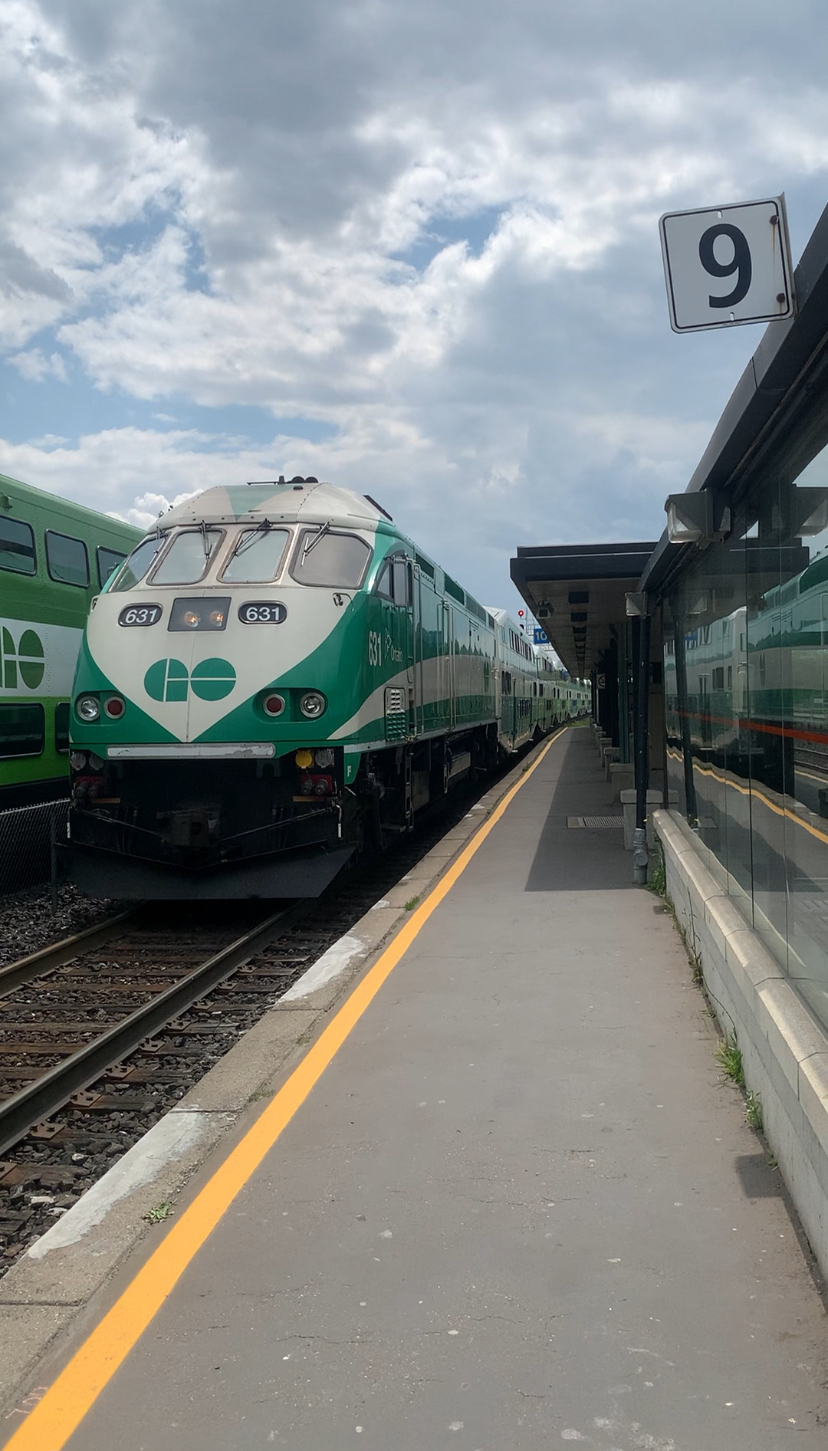
GO Train – City News Toronto

Make your way from wherever in the Greater Toronto Area you reside, to Union Station, or your nearest Lakeshore West line stop, and jump on the Lakeshore West GO Train stopping in Niagara Falls. Make sure that the train does stop at Niagara Falls, as only three trains per day go the full legnth of the line each way. Several Lakeshore West trains terminate in Aldershot, Hamilton, and Oakville. The train takes around 2.5 hours to arrive at the falls and has bathrooms on-board but you’ll need to bring your own snacks or drinks for the ride.

While the train is a bit on the more expensive side, it’s still one of the best ways to reach the falls without a car. If you have time to plan your trip ahead, the best way to see the falls is the GO Weekend Pass which has unlimited travel on any GO busses and trains for the day for only $10.00! The GO Weekend Pass also works for Canadian and Ontario Public Holidays too, bonus!

Go Transit Fees (1x Return Trip)
Adult (Eticket or Credit/Debit Card)$42.30
Adult (PRESTO)$36.18
Student (PRESTO)$21.78
Senior (Eticket or Credit/Debit Card)$21.20
Senior (PRESTO)$19.26
GO Weekend Pass (BEST VALUE)$10.00

After arriving at the Niagara Falls GO station, keep in mind that the falls themselves are not next to the station. You can either pay in cash to take the Niagara Transit busses ($3.50 each way), which will get you to the falls in five-to-ten minutes, taking the 603 or 204 bus and getting off at Victoria Ave, or walking to the falls which takes about 30 minutes. Keep in mind that in addition to this, the walkway to the falls themselves is about fifteen to twenty minutes walk each way, depending on your fitness, and the density of the crowd.

Should you be driving to the falls, the usual soutbound route from Toronto is to take the 403/QEW. Without traffic this usually takes about an hour, to an hour and a half depending on where you are in the GTA. Upon arrival in Niagara Falls, parking is usually paid, and the typical rule-of-thumb is that it’s more expensive the closer to the falls you get, with far away parking lots charging $5 for the day, and closer ones charging between up to $25. Keep in mind these prices fluxuate and may be more expensive on event days.

But I’ve got a secret for you! Some local Ontario knowledge passed onto me is if you don’t mind a ten minute walk, you can get free parking by parking next to the cereal factory, Post Foods Canada. There is several free parking spaces along Lorne Street and Centre Street that mean you’ll only be ten minutes from the action, and you’ll walk right through Clifton Hill (More on Clifton Hill Later)! Should these parking spaces be taken, some of the other residential streets north or westbound often have free parking as well.

Should you be flying in to view the falls, the best international airports to access the falls from (and can still connect with GO Transit) is Hamilton’s John C. Munro (YHM), or Toronto’s Billy Bishop (YTZ), or Pearson (YYZ)

United States

Prices marked in USD for this section
While most Kiwis reading this will be residing in Canada, some of you may be trying to access the falls from the American side. I strongly reccomment you bring your passport (and your Canadian work permit, if applicable!) to view the falls from the Canadian side. The border crossing is very quick off-peak and is one of the few crossings that is relatively easy to walk accross!

The nearest major U.S city is Buffalo, so we’ll use that as a starting point for this guide. The nearest international airports are in Cleveland and of course, New York City. Both cities mentioned connect with Buffalo via Greyhound, and New Yorkers can go straight to the falls via Flixbus.

Accessing the falls can be done via Buffalo’s public transport network, but it takes two hours, and two busses, to cover a very short distance, and runs infrequently. Still, those interested can purchase bus tickets using cash ($8 return, $2 per bus), or their MetGo smart card/app, which caps at $5 per day.

For a faster ride, albiet sometimes a bit more expensive, travellers can take the Flixbus from Buffalo to Niagara Falls which takes about 30 minutes, or the Empire Amtrak service which takes about 45 minutes.

Driving to Niagara Falls from Buffalo takes roughly 25 to 35 minutes depending on traffic.

The Falls

The Niagara Falls are one of the most impressive sights in Canada. While the commercialization of the location has hampered the natural beauty of the region, seeing the falls with your own eyes is now just only one part of the whole experience.

Before diving in, did you know that New Zealand has its own Niagara Falls? Yes, with the same name too (Mānga Piri)! Ironically, these falls, located in the small locality of Niagara to the west of Catlins Forest Park, are possibly the smallest in the region, if not the nation. Visit at your own risk of disappointment!

Niagara Falls – Joseph Simpson

Viewing the Niagara Falls is best done from the Canadian side, as mentioned, and can be done via walking the Fallsview trail. Starting at Clifton Hill and making your way down to the water’s edge, each way takes about ten minutes, but factoring in stops and lots of other tourists present, it will take you slightly longer. Along the walk there are several small parks that are great spots for a picnic, a stroll, or a rest. Niagara Parks are constantly running free programming in these little areas too! I had the pleasure of watching Canada versus Qatar in this year’s FIFA World Cup from the falls this year. There are also plenty of spots to grab a drink or a bite both toward the middle and end of the trail. While I was surprised to see these weren’t total daylight robbery, expect to pay a bit more than you are used to.

On your walk is also the access to several Niagara Falls activities. The two best known ones would be the Voyage to the falls boat tour (not to be confused with Maid of the Mist, which is the tour operator on the U.S side), and the Zipline to the falls. Both of these bucket-list activities are worth a visit, but keep in mind that they both get very busy, so plan ahead and aim to get there early! Also check their operating times as they vary from season to season.

There are several other brilliant activities that can be done in and around the falls and the best way to experience them is the Niagara Falls Pass. This pass, as with others mentioned in this article, bundle activities together for 22% – 52% in savings. The passes feature either all of, or select attractions of, this list:

  • Journey Behind the Fall (Day or Night)
  • Niagara Takes Flight
  • White Water WalkWhirlpool Aero Car
  • Butterfly Conservatory
  • Niagara Parks Power Station
  • Self-Guided Admission (Day or Night)
  • Floral Showhouse
  • All 4 Heritage Sites

Other activities that are close to the falls are almost all provided by Niagara Parks. They are the main tourism and conservation authority in the area and for those who are looking for more green spaces, this is the place to look. One of my favourite places you can enjoy is the Niagara Glen, which takes you along a more isolated part of the river (although keep an eye out for the occasional jet boat), and gives spectacular views of the water and the escarpment. They also run several conservation events, from cleanups to tree planting, which is worth a little look into if that’s more your speed!

Niagara Glen & Tree Planting with Niagara Parks – Joseph Simpson

Clifton Hill

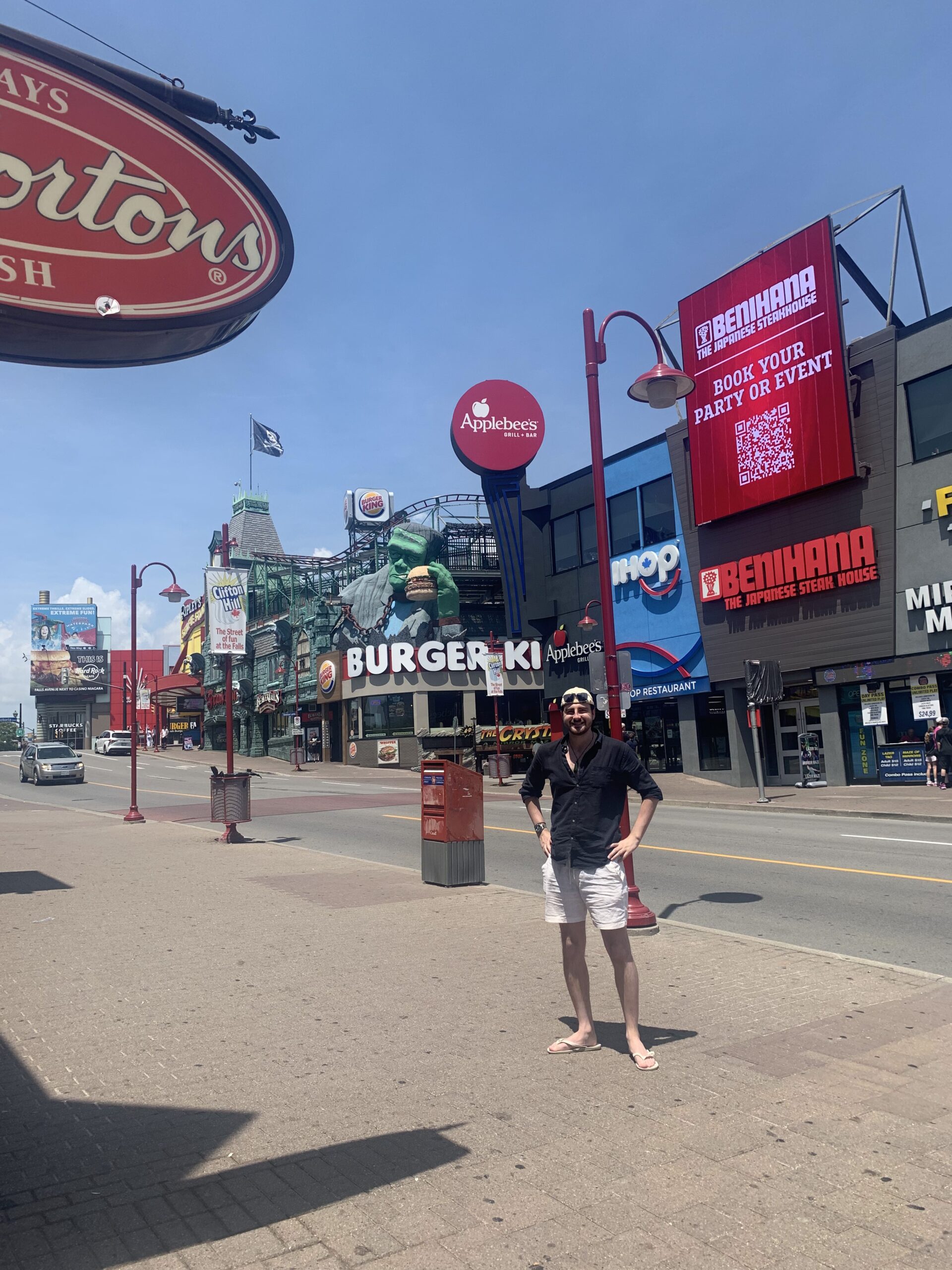
Upon arrival at Niagara Falls, particularly if you take the bus in, or opt for free parking, there’s a high chance you will walk down Centre Street onto Clifton Hill, and your jaw will drop.

While I thoroughly enjoyed my visit to the falls, I believe the reputation of them softened the blow they had on my feeble New Zealand worldview. I knew it was the biggest waterfall in the world (in terms of volume of water falling, at about 2.8 million litres every second!) and when I saw them, it blew me away, but nothing prepared me for Clifton Hill.

Clifton Hill – Joseph Simpson

If you’ve ever been to Canada’s Wonderland, or the Canadian National Exhibition (CNE), picture one of these places, only it’s a street, a permanent street within a few minutes walk of the falls view trail. Clifton Hill is what late-stage capitalism dreams of. I felt like a kid straight out of a movie. The mix of vibrant and saturated colours, combined with a backdrop of North American brutalist architecture, makes for a spectacle that certainly won’t be replicated anywhere else in the world, or at least not outside of the continent.

Clifton hill is an entertainment district that features several different wortwhile things to see. From great places to eat, including both local diners and chain restaurants, to awesome attractions and shopping opportunities. Highlights for me are the Hershey’s Chocolate World, Hard Rock Cafe, and Coca Cola store, all located on Falls Ave. On Clifton Hill itself are several great souvineir stores, Rainforest Cafe, the Fudge Factory, and several brilliant souvineir stores.

In terms of the attractions, there are so many fun things to do along Clifton hill, from wax museums to mini golf. The prices of these attractions however is very steep if you buy individual passes to each event, so I recommend either finding one of the ticket booths, or heading online to purchase a FUN PASS, or at least one of the other pass options, as they save you around 30% to 50% per attraction!

Niagara-On-The-Lake

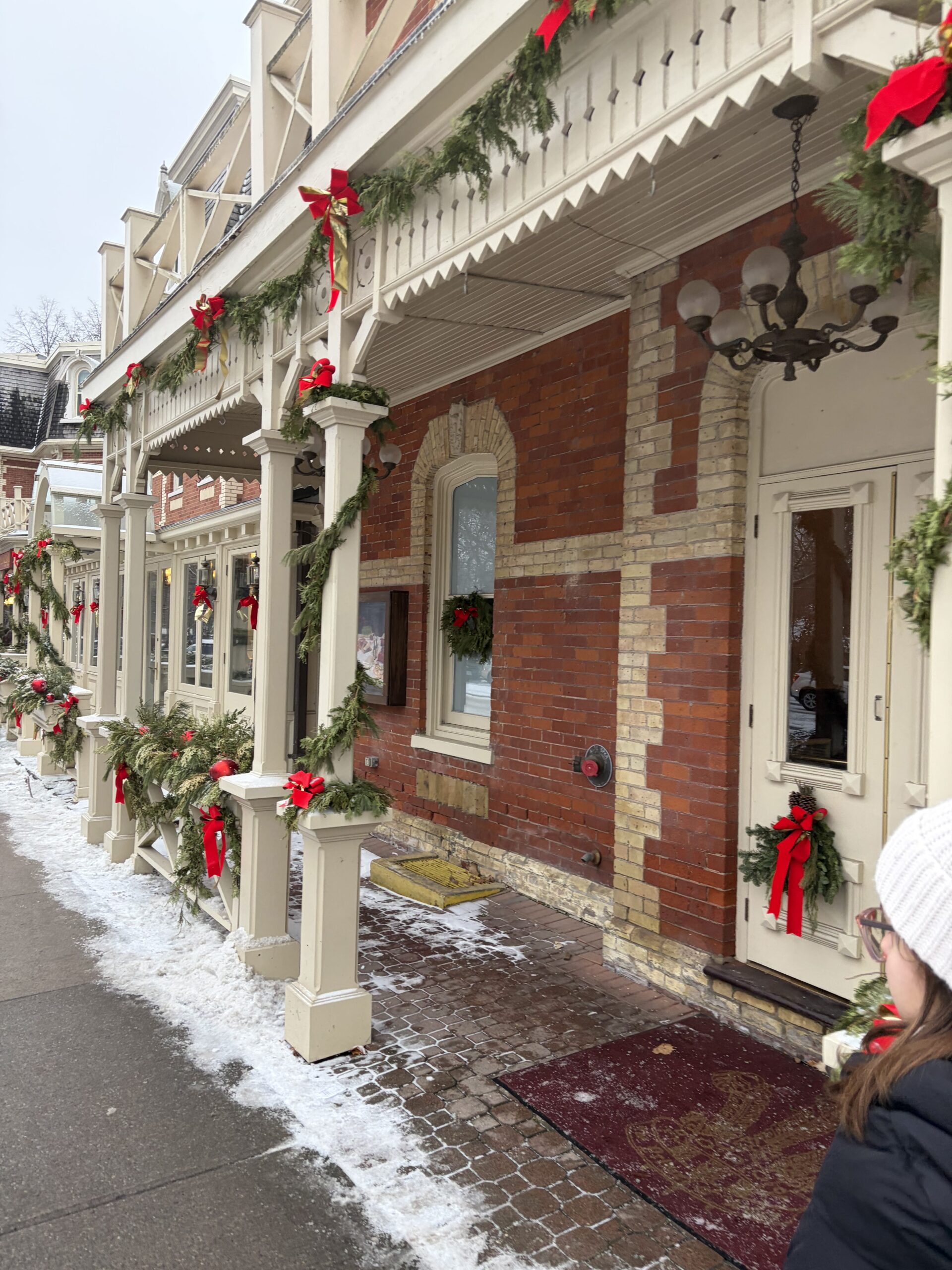
One of the many festively decorated buildings in Niagara-On-The-Lake during Christmas – Joseph Simpson

Niagara-On-The-Lake is another place that is well-known amongst southern Ontario locals, wine lovers and select international tourists, but criminally under appreciated by everyone else.

This historic township is just a short drive away from the falls (or about an hour and a half by bus), is such a gorgeous and quaint town, you don’t need a long time to see it all, but just like an intersting museum, you can spend hours and only cover a short distance, entering each store or pub or restauarant. There are several historic sights in the region, including several old buildings and fortifications from the War of 1812, most of which are free to visit thanks to the Canada Strong Pass that has run over the past two summers.

Speaking of summer, both the falls and Niagara-On-The-Lake are beautiful any time of year! Summer, autumn, spring or winter, the changing of the seasons is far more noticeable in Canada than New Zealand, largely due to the snow, and the far higher quantity of deciduous trees versus evergreens. The Christmas decorations here make it worth visiting during the winter wonderland!

Vineyards near, and around the falls and Niagara-On-The-Lake are some of the best in Canada and North America. I went to research them, but there are over forty in the area alone, so if this is something you are interested in experiencing check out this link!

Lastly, shopping. The Niagara Outlets are a good spot to find brand labels for great prices, and are close to both Niagara-On-The-Lake and the falls. There’s also a brilliant Bass Pro Shop next to the outlets too! If you’re over the U.S side, there are also outlet shops nearby that are highly rated.

Buffalo (USA)

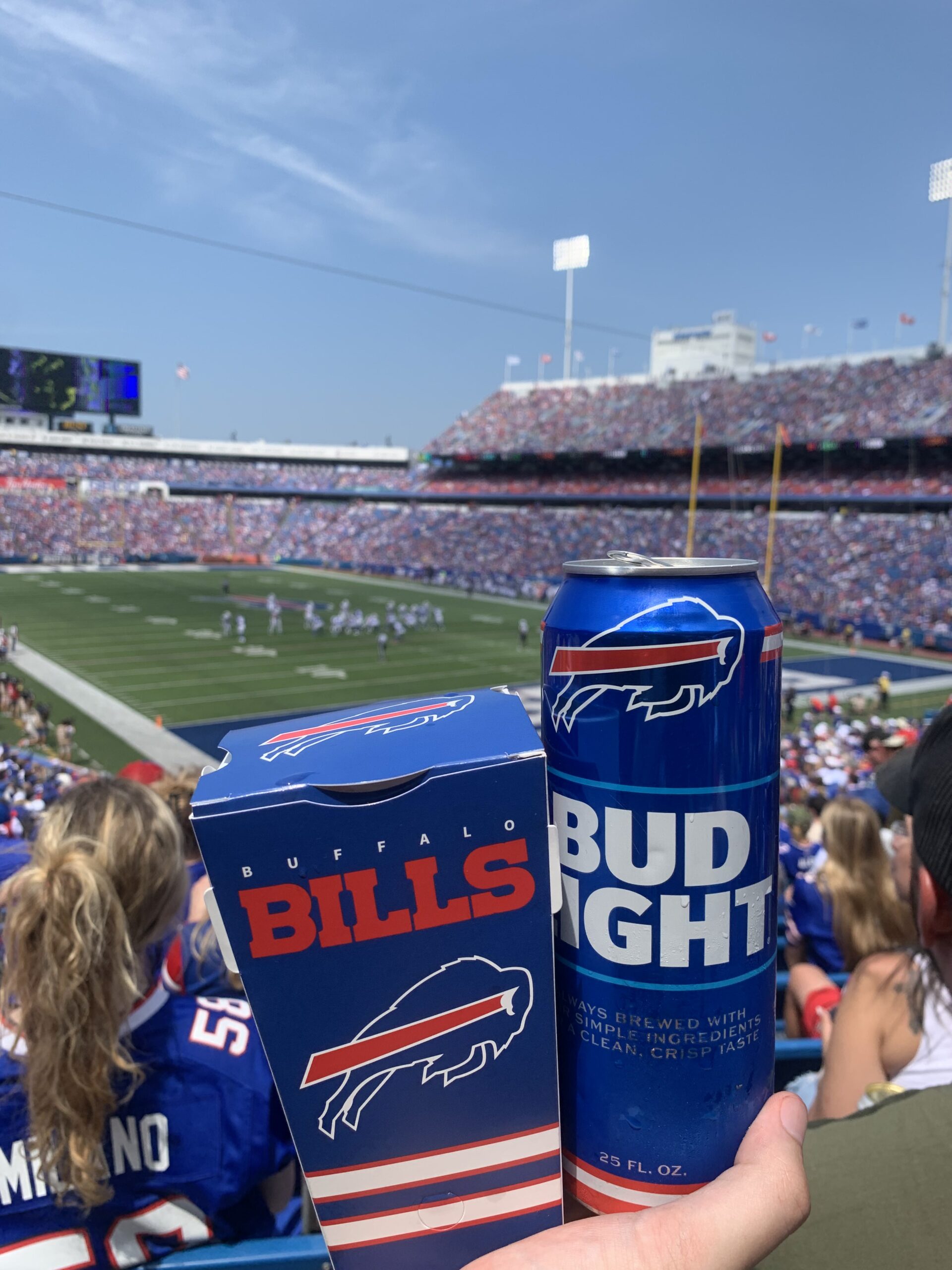
Old Highmark Stadium, Buffalo Bills versus New York Giants. Ironically, the Buffalo Bills are the only NFL team actually within New York state! – Joseph Simpson

It’s only fair we throw our friends south of the border a bone and mention some of the fun things to do in Buffalo too. It is right there, after all! While the USA’s side of the falls has essentially the same amenities as the Canadian side, without the spectacular view, Buffalo is certainly the most intersting city within a short distance of the falls (sorry St. Catharines!).

Buffalo, despite being on the smaller size of a U.S city, is home to two sports teams in the US Major Leagues, namely the Buffalo Bills in the NFL and the Buffalo Sabres in the NHL.

As Canada do not (currently) have a team in the NFL, The Buffalo Bills market themselves as Canada’s team, and have played several matches on the better side of the falls. If you are familliar with Ontario, you’ll know that on certain Sundays when Buffalo is playing home games the border crossing can take slightly longer as Canadian fans jump over to get their football fix! Earlier in the year the Bills moved to a brand new and improved stadium with the same name as their old one, Highmark Stadium, so the photo you can see in this article is unfortunately not true to the current viewing experience, but

Should you be visiting the falls in the Autumn or Winter, and there be no NFL action on, you can catch a Buffalo Sabres game. You might be wondering why bother? Toronto already has a team, the Maple Leafs! Well… if you’ve had a go at buying Leafs tickets in recent history, you’ll know the cheap seats make an All Blacks game back home look like a freebie! The best part about the Buffalo Sabres? They consistently have the cheapest ticket prices in the entire league, and by a large margin too! You can expect to pay half, or sometimes a third, of Maple Leaf’s prices!

Some other significant attractions in Buffalo are:
– Buffalo AKG Art Museum
– Shea’s Buffalo Theatre
– Buffalo Naval Park
– Theodore Roosevelt Inaugural National Historic Site

So that’s a kiwis guide, for kiwis, to Niagara Falls. A superb destination no matter what time of year you’re there. What makes it special? Well, the falls are spectacular, but I’d argue it’s all the things to see and do in a little nook separated by two of the worlds largest countries. Plan your visit today!

Article by Joseph Simpson, 9th August 2026
Want to know more? Reach out to Joseph via our Facebook and Instagram channels


Previous articles:

  • All Blacks fall short in Greatest Rivalry equaliser
  • Six60 Rock Pier Six Pavilion
  • Niagara Falls: A Guide
  • Ryan Fox Chases History at the 2026 RBC Canadian Open
  • New Zealand Pre-Match Parties – Vancouver
Read More about Niagara Falls: A Guide
Posted By Joseph Simpson Posted on August 10, 2026
Posted inCanada News Sports

The Canadian Football League, the “Rugby League” of American Football

Featured Image: Hamilton Tiger Cats host Ottawa Redblacks – Joseph Simpson

May marks start to preseason for the Canadian Football League (CFL), and with it, probably one of Canada’s best kept secrets. While Hockey and Lacrosse have reputations as quintissential Canadian sports globally, their own version of American Football, is often not heard of outside of North America. Even athletes from the United States who don’t make the cut for the sport’s far better known and competitive NFL, often find out about the league shortly before signing into it. It’s a sport, and a professional league, that is strictly Canadian.

Grassroots Canadian Football

As a newcomer to Canada, I was surprised to find out about the sporting practices at grassroots level differ significantly from the experiences we have back home in New Zealand. The two differences appear to be firstly, that schools often only field one team per gender per sport, don’t make the first XI soccer team? There’s no second XI, you’ll have to go and find a club to play with this year and try again next year. The second is that because of this competitive nature to even making the team, most sports have grassroots pathways that focus strictly on clubs, and have separate options for those not competing at secondary school. A clear example of this is Ice Hockey. Is all of the High School going down to the rink ahead of the big game? You’d be wrong. Hockey is largely played outside of education institutions, the truth is, they’re all off to watch their High School Football Team. How Canadian!

All jokes aside, it is very Canadian, and one of the most well attended sports in North America. In fact, with an average of 20,000 spectators a game, sits in third place only behind the NFL and Major League Baseball in attendance records. That’s right, the CFL has more consistent attendances than Hockey!

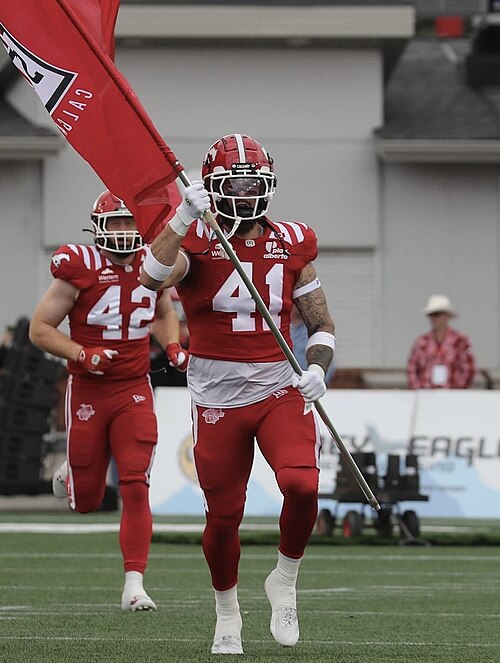
Calgary Stampeders Linebacker Nicky Farinaccio

The CFL

Canadian Football is a nine-team competition that spans the width of the nation, with the exception of the anxiously anticipated Atlantic Canada. The season and post-season runs for about six months mostly over the late spring through summer, usually wrapping up as Hockey and Lacrosse take the stage.

For those reading this in Toronto, you will be happy to know that there is a local team bleeding blue and white, the Argos. The often overlooked member of MLSE, Toronto have produced some great results in the recent history, winning the competition in 2022 and 2025. Readers in Vancouver will be also happy to know that their province is home to the BC lions, less happy to know they are, and have been for a long time, frankly, rubbish.

While not hotspots for New Zealanders, some of the teams with the strongest fanbases are in Edmonton, Alberta and Hamilton, Ontario. The Elks and Tiger-Cats respectively have a rich history in the league, with several championships, while recent history hasn’t been kind, their fans remember glory days and whether it’s a great atmosphere, daunting chants, or their rich histories, these two teams have got it all.

But the team to watch seems to be the Saskatchewan Roughriders, the only professional sports team in Regina, and one of only two in the province alongside Sakatoon’s Saskatchewan Rush, the local Lacrosse team. Perhaps its the lack of other things to do in the city, or the fact that the reigning champions have been on fire last season and many more beforehand, but the often forgotten prarie province makes their voice heard every week in Canadian Football.

If you do get a chance to go to a CFL game, I’d highly recommend going to one of the derby matches between rivals, as this is where the atmosphere is at its height. And luckily, all of these fixtures happen at least once a year on Labour day in the iconic Labour Day Classic. In Alberta the Calgary Stampede comes early when the Calgary Stampeders (Yes, that’s their name) host the Edmonton Elks. In Ontario, the Toronto Argos and Hamilton Tiger-Cats is such a fierce rivalry they chant obscenities about eachother even when the opposition is a different team! The french speaking Montreal Alouettes are arguably rivals of all Ontario teams, but Ottawas Redblacks is certainly the team to beat for fans every year. And while quite far away from eachother, Saskatchewan’s Roughriders have also seen a rivalry form against the Winnipeg Blue Bombers, as both teams have risen to be dominant forces in the competition at similar times.

The full list of teams are:

  • British Columbia – BC Lions
  • Alberta – Calgary Stampeders
  • Alberta – Edmonton Elks
  • Saskatchewan – Saskatchewan Roughriders
  • Manitoba – Winnipeg Blue Bombers
  • Ontario – Hamilton Tiger-Cats
  • Ontario – Ottawa Redblacks
  • Ontario – Toronto Argos
  • Quebec – Montreal Alouettes

The Rules

The 2025 Grey Cup Final was contested between the Saskatchewan Roughriders and Montreal Alouettes – Canadian Football League

What excatly makes Canadian Football unique from it’s U.S equivalent is similar to the differences between our favourites Rugby Union and Rugby League. As with League’s limit on phases and a faster uncontested set piece, making for overall a usually quicker game. The CFL’s differences to the NFL acheive a similar result. In the CFL, the limit on “downs” , essentially phases or passages of play, is just three, this makes a more pass-heavy game, with more than one pass far more common than the American game, and makes the attack more aggressive in achieving their 10-yard reset on their downs. There’s also a lot more space to move the ball, with 110 yards of legnth to the main field (compared to NFL’s 100), 65 yards of width (compared to NFL’s 53.5) and a huge end zone of 20 yards (compared to NFL’s 10). The extended end zone also sees far more defensive plays inside, as teams failing to run missed kicks out of thier end zone still concede 1 point. To make up for this extra space, pace, and further defensive challenges, Canadian Football is a twelve-a-side game, although the additional player certainly doesn’t slow down the game in any way. There are several other small differences between the codes.

Personally, I would say, as a huge fan of both codes of rugby, that Canadian football makes up significant ground that make American Football often so difficult to watch for those outside of North America, the increased pace of the game being the most important. While it won’t knock your New Zealand merino wool socks proudly purchased at Mitre 10 off, I personally found my CFL experience at the Tim Hortons Field far more enjoyable than NFL’s Highmark Stadium south of the border.

The rules, just like league and union are in a constant state of flux, but whereas the two rugby code’s lawmakers are constantly trying to out-innovate eachother, Canadian Football’s attitue is more sympathetic to the American code, much to the dismay of locals.

Rules are constantly being tweaked to make the game be more like the NFL. A big part of this is due to the differing dynamics between the codes compared to Union and League. While Union is the dominant international code worldwide, and club code in all of the Northern Hemisphere apart from about five villages in Northern England, League’s NRL is certainly a heavyweight competitor for attention. NRL and Super Rugby are at eachother’s throats over stadium and television viewership and it is not uncommon for cross-code players to float between each competition, with at least one making the switch to either every year.

The CFL-NFL debate

The NFL does not have the global reach of other internationally recognised sports, let alone North American-born sports. While their exhibition games are crowd-bringers, it hasn’t translated into strong grassroots interest or significant development into domestic competitons. Outside of a small number of European countries, most notably, Austria, Great Britain, and Germany (Fun fact: the Austrian Under-20s team in a famous recent upset, beat the USA in the bronze medal match), Canada is the only real country with a strong interest in the sport and the team to back it up. In fact, as of May 2026, the last three Junior football championships, Canada have been champions.

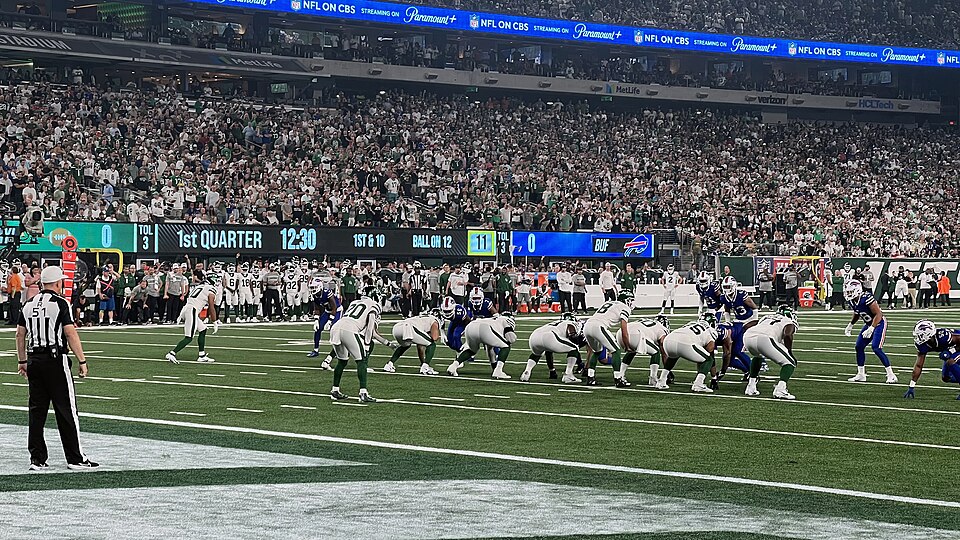
Buffalo Bills versus New York Jets – Jim Greenhill

While NCAA Football will likely always reign supreme as the feeder for the NFL, for foreigners, older players, or undrafted players, there isn’t a huge amount of leagues they can play in that are a high enough level that they can keep within the sights of scouts and coaches, an issue prospects in most other sports don’t have, there isn’t an NFL story just like Marty Banks’ journey from playing deep in the Russian Federation’s heartland before that fateful 2015 Highlanders championship.

Europe’s American Football League, one of the only other professional leagues outside of the U.S and Canada, has seen great instability in it’s short-lived history, with the previous administration of the European League of Football essentially folding due to a team revolt. A new league, largely based around Central Europe, is kicking off this month. Hamburg and Frankfurt’s ineptitude make crossing the Atlantic a risky place for any journeyman American to play their beloved sport. This leaves only one option.

Canada, as the only other country with a strong interest in the sport domestically, have seen more and more players from south of the border cross over to join their teams, combined with the fruits of their junior programme’s labour leading to the highest amount of active Canadian players in the NFL in their history, and NFL interest at an all-time high, with sometimes half the crowd of a Buffalo Bills game coming from Ontario, CFL teams are essentially becoming feeders to the NFL. This puts Canadian rulemakers and directors at a difficult crossroads. Do they cave into the pressure from the NFL and adjust their game to play more similar to the American, or outright abolish their own, rules of the game, becoming vassals? The NFL’s 51st state, if you will. Or will they stay true to their roots, and keep the CFL a game strictly by Canadians, for Canadians? The first option might set off alarm bells in your head, but caving in would likely provide huge amounts of American cash, and see more Canadian’s in the NFL. Heck, Toronto might one day cast off their rose coloured glasses for the Buffalo Bills and cheer for their own NFL team.

My thoughts are this: Right now, Canadian Football are still a quintissentially Canadian sport, and that might be the case forever, or, it might not be. Rather than waiting around to find out, the best thing you can do is purchase a ticket, go down and support your local team, particularly get amongst the great rivalries between the Argos and Tiger-Cats, Alouettes and Redblacks, Elks and Stampeders, and raise a glass to this brilliant game, because all good things must come to an end.

Article by Joseph Simpson, 16th May 2026
Want to know more? Reach out to Joseph via our Facebook and Instagram channels.
Read More about The Canadian Football League, the “Rugby League” of American Football
Posted By Joseph Simpson Posted on May 16, 2026
Posted inCanada Home News Sports

What’s the deal with the CPL?

Featured Image Credit: Canadian Premier League

Picture this: It’s May 2006. You’re watching rugby on the TV. Not just any game, the Super Rugby Final, Crusaders versus Hurricanes. Both teams have been indeniably on-form, and are both leaps and bounds ahead of any other team. This is the most anticipated rugby game of 2006. But when you flick on the television you can barely see anything. Half the field is coated in a thick haze, the commentators sound clueless, and any time the ball is kicked, nobody, not even the players, know where it’s gone. It’s the Final In The Fog.

Canada might not have their “Fog Final,” but they do have their −1 °C “icicle kick” scored in the 2025 CPL final. A final that will go down cult history as it was played in a snowstorm.

Canada’s penultimate football/soccer competition might not initially be on your radar as a newcomer to the country, especially as a Kiwi. After all, there’s ice hockey, Canadian football, lacrosse, baseball and so many other sports that aren’t popular back home to enjoy. This was certainly my attitude when I recieved free tickets to my first game on James Street in Hamilton, Ontario. After attending several games now, I can share with you that this is in fact a competition worth watching, and will give those missing their A League fix a great opportunity to watch football at a better price than Major League Soccer or the International game.

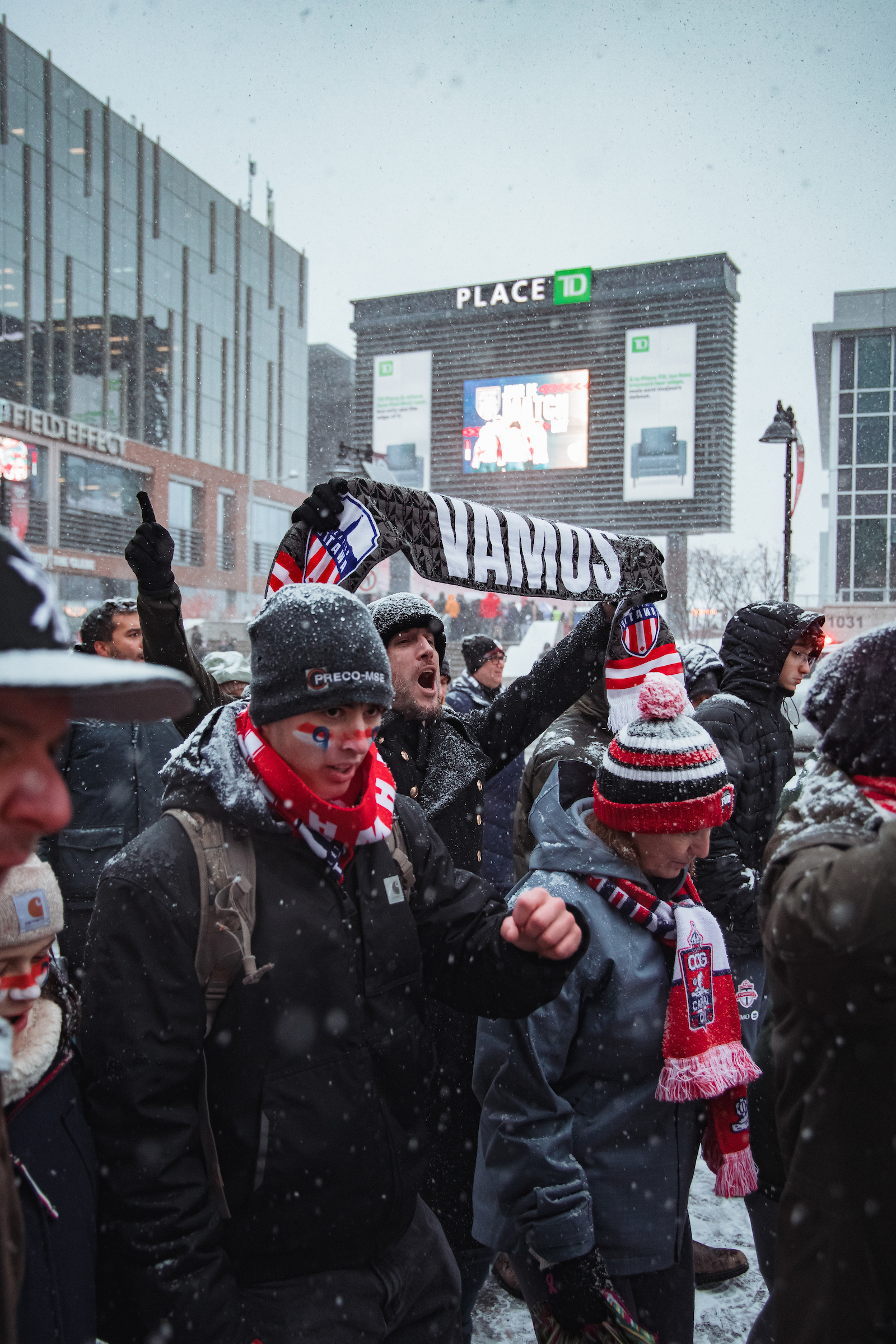
Ottawa’s supporters ahead of last year’s final – CPL

While football might not be on every New Zealanders radar. Admittedly, it’s been almost three years since I’ve supported my local team, the Wellington Phoenix, back when Eden Park and Auckland were considered a second home base, it’s currently incredibly topical, particularly for those of us in North America.

New Zealand football touched down in Toronto in June last year for the Canadian Shield Tournament, bringing countries together from four different continents, the All Whites found themseves underdogs against African and European heavy hitters Côte d’Ivoire and Ukraine. In a shock turn of events, the Kiwis toppled the at the time reigning African champions, finishing the tournament in second place after a narrow loss to Ukraine. It was a phenominal spectacle

Combined with the impending World Cup which will see the All Whites play two of their pool matches in Vancouver, Canada, against Belgium and Egypt, and further matches south of the border such as their pool match against Iran and warm-up against the formiddable English, the number of North American has dominated the mind of New Zealand sports fans living in this part of the world all year.

While the All Blacks taking on the Springboks in Baltimore, Maryland will be a battle for the ages, Sail GP coming to Halifax, Nova Scotia and the Sevens getting tournaments in Vancouver, BC and New York (Actually, New Jersey!) are all incredibly exciting, this year is certainly the year of football, soccer, whatever you’d like to call it. But with the first matches not until June, where can you get your fix in the meantime? The answer is the CPL.

What is the Canadian Premier League?

The Canadian Premier League (CPL) is the second flight of Canadian football, and the largest competition solely played in Canada. It sits behind only Canada’s three Major League Soccer (MLS) teams based in Montreal, Toronto and Vancouver. Major League Soccer is likely more well-known to those from outside of Canada, and has fielded some exciting results in recent history, such as Toronto FC’s record-setting championship season in 2017, and just as of last year, the Vancouver Whitecaps made the final.

While the MLS is an exciting competition, the CPL is a suprising dark horse that can often be seen as a feeder for these three clubs, but in reality, is so much more. The CPL consists of eight clubs spread all accross Canada, from the Atlantic to the Pacific. Most kiwis are lucky to be concentrated in British Columbia and Ontario, the only provinces with multiple teams. BC field teams in Vancouver, and Victoria on Vancouver Island, meanwhile there is a team to watch in Ontario if you live in or nearby Hamilton, Ottawa, or last but certainly not least, Toronto.

Toronto versus Hamilton is one of the many rivalries of the league – Michael Chisholm/Canadian Premier League

So what makes this league worth a watch? Aside from the typically far cheaper tickets (Although certain teams with strong followings such as the Halifax Wanderers and Forge FC are slightly more expensive), it’s often just great football to watch, and there will be a team that you can get behind with a style that resonates with you. The previously mentioned Forge FC of Hamilton, alongside Calgary’s Cavalry and Ottawa’s Atlético are certainly reminiscent in terms of their organisation to that of your favourite Auckland FC and Wellington Phoenix. These clubs were the top three performers in 2025 by a country mile. If you’re more into scrappy, shin bruising, Fielding High School Second XI type of football, then one of the ragtag groups from Inter Toronto FC or Pacific FC might be your team to get behind.

This is however, the biggest drawback to the competition at present. In seven seasons thus far, the Hamilton’s Forge FC has dominated with four championships and three regular season wins. Who’s right behind them? Cavalry and Atlético. It’s a story we’ve heard before in football competitions around the world, such as the Scottish Premiership giving us what feels like half a century of Glaswegian dominance, with Celtic and Rangers passing titles to eachother like it’s a tennis match. With only in 2026, Edinburgh’s Hearts are looking like the first team in decades to challenge that duopoly. The difference between the Canadians and the Scots? There is distinct heritage, investment and cult followings behind each and every one of them. It’s not to say that football clubs in the home islands don’t run into financial trouble, or even go into slumps that their supporters rue the day they reminisce, but more often than not, they bounce back.

Just like many other fledling North American sports leagues in the last decade, the Canadian Premier League, founded in 2019, has already seen several clubs change hands, fold and be reborn, or just cease to exist permanently. Out of all the clubs present in the 2026 season I can safely say only half are likley to be secure in their future as a football franchise in Canada, even last year, due to low attendance and interest, Winnipeg concluded the season for the last time, denying the league an opportunity to have a record eight teams with the introduction of Montreal’s FC Supra du Québec. It’s worth noting that fan speculation on the internet rarely had Winnipeg in mind for a potential team to fold in 2025, with the West Coast teams in particular possibly on the chopping block in the future, if you ask a typical Instagram or Reddit commenter.

In amongst all these trials and tribulations though, you get some brilliant football, and for the first time ever, the Canadian Premier League rocked global headlines with their final last year.

The 2025 CPL Final: Cavalry FC v Atlético Ottawa

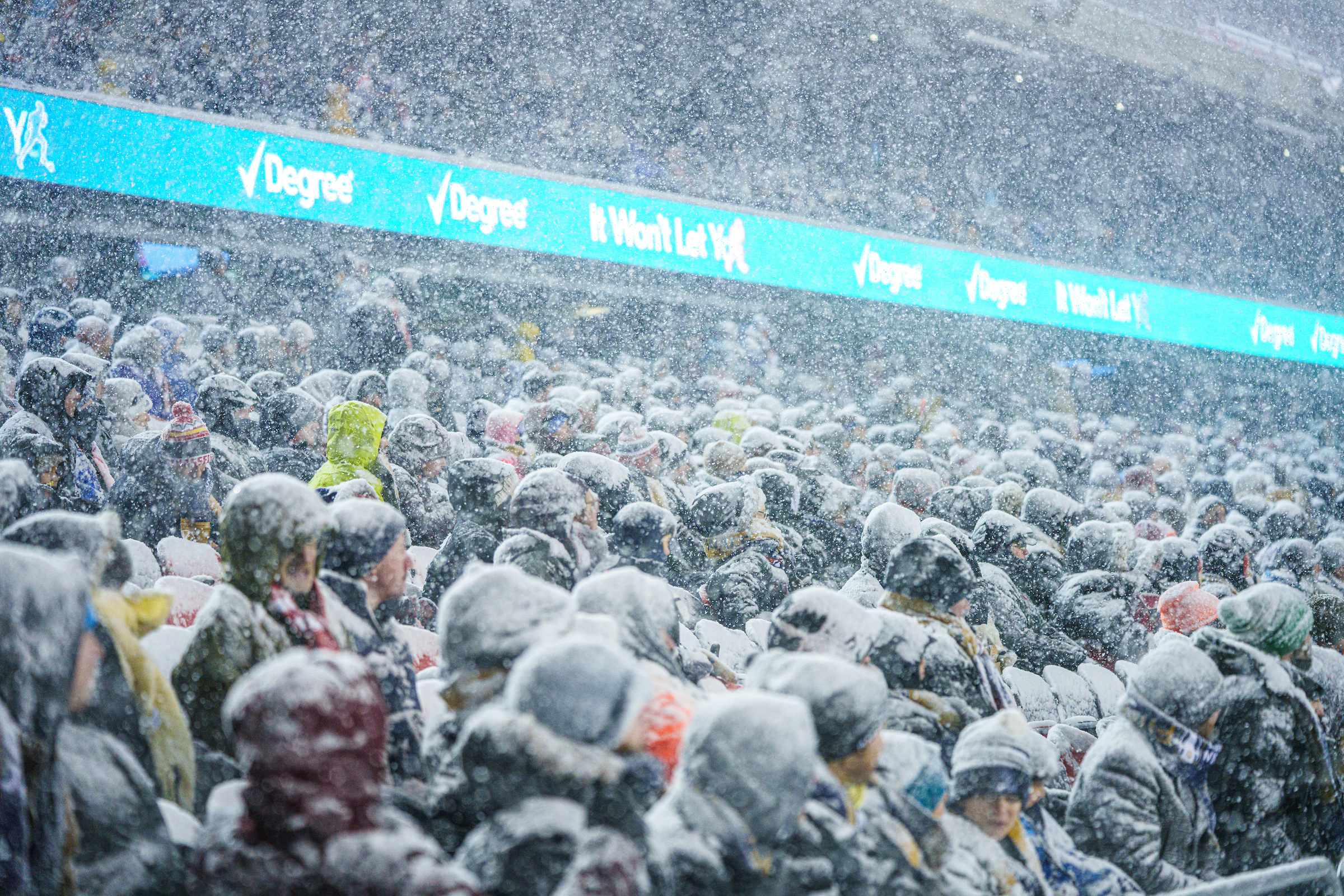
Snow kept the battle close-quarters – David Chant / Cavalry FC

The 2025 season finished in what some might call a typical fashion for the league. Hamilton’s Forge FC won the regular season title, sitting in a comfortable first, and comfortable favourites. Then the unexpected happened, Ottawa, then Calgary, both travelled to the Hammer and won difficult away games to knock out the title favourites and set the stage for the Ottawa to host the CPL final for the second time in their clubs short history.

Atlético Ottawa, founded by Atlético Madrid in 2020, had the homefield advantage, and the advantage of being able to draw players from Madrid’s network of clubs they own around the world, Auckland FC getting a leg up thanks to Bournemouth, if you will. The Team also featured 29 year old New Zealander Monty Patterson, who after a couple seasons with amateaur and semi-professional teams back home, found himself in Ottawa for the 2025 season.

Cavalry FC, one of the founding clubs of the CPL, also looked on-form and had won the previous year in another upset win over the Forge FC. While certainly not favourites in the matchup, with a previous win and two regular season titles under their belt, the Cavalry had the accolades to suggest there would certainly be fight in them. Invercargill born midfielder Jay Herdman is the closest a New Zealander got to Cavalry’s finals squad, unfortunately placed on loan to Vancouver FC toward the end of the season.

Thirteen thousand fans entered Ottawa’s TD Place, just narrowly falling short of the finals attendance record the city had previously set a few years prior, warm jackets, toques and gloves covering the jerseys of supporters. It’s worth noting that many of these fans would have been learning that they even had a CPL team for the first time! Probably a better watch than Ottawa’s capitulation to Toronto in the Stanely Cup playoffs that year.

Too cold for supporters jerseys – David Chant / Cavalry FC

Prepare for some deja vu, and some brain freeze. Snowy conditions meant that there was a potential need to postpone the game, but as with a certain final in 2006, two decades on, they decided to press on. Even as the teams exited the tunnels, the football field was covered in a white blanket of snow.

The game kicked off with some real tenacity from both sides, but whether it was the subzero temperatures, the snow on the field, the stop-start nature of the game as they cleared the field, or the crowd presence, the errors kept building up. It’s hard to say who was in control. Ottawa looked particularly strong on the attack, with Mexican-born David Rodríguez shooting on target and exploiting Cavalry FC’s errors, but David, alongside the rest of Ottawa’s attack, couldn’t connect the ball in the net, the snow clearly adding drag to their boots and the ball, sending it in all sorts of directions.

What Cavalry FC lacked in star power and an ability to capitalise on errors, they made up for with a burning desire to maintain possession at all costs, sacraficing field position to hold on to the ball occasionally. Their greed did in fact, eventually work in their favour. Cavalry’s Fraser Aird struck a penalty in the box which was by no means glamorous, but might go down in history as one of the worst keeper efforts by Ottawa’s captain and keeper, Nathan Ingham. The ball thumped and barged along the snow at a snails pace, like an Antarctic icebreaker, or one of those underarm bowls you do for your youngest nephew in backyard cricket, yet Cavalry FC now held the advantage.

After Cavalry celebrations finished up, in amongst a hail of snowballs from the upset crowd, play was resumed and a fire was lit in both teams. Ottawa’s David Rodríguez, several attempts later, finally had fortune favour him in the antithesis to Aird’s penalty, sent an extrodinary bicycle kick into Cavalry’s net off a disorganised corner that was so magnificent, it has rightfully earned it’s title of the “icicle kick” around the world and is possibly the greatest goal ever scored in the Canadian Premier League.

David Rodriguez earns an incredibly unique celebrations – Tim Austen / CPL

While filed with elation, the snow kept Ottawa or Calgary from capitalising on thier respective goals. The Snow maintained it’s authority on the field for the remainder of the half, and well into the second half. Toward the end of the second, patches of green could finally be seen, and the pace properly picked up, not before the game could go into extra time.

This is when we could finally see the talents of the attack on full display, as the first one-hundred-and-fifty minutes of this three hour battle had been dominated by stalward defensive efforts from both sides, Ottawa’s Roni Mbomio, Noah Abatneh and Loïc Cloutier certainly standout players. But all glory to the plucky Mexican, on loan from another “Atlético” with the last laugh, chipping another beautifully controlled strike, with the only other in the game being his previous goal, straight over the keeper to seal the game for the home side. Ottawa were 2025 CPL champions.

Deserving WInners – Canadian Premier League
The Man of the Hour – Canadian Premier League


This game alone, makes this league worth watching. The weather a metaphor for the play that for five minutes might look like you’re watching Liverpool take on Chelsea, then the next twenty make you think the Chatham Islands might field a better team. It’s scrappy, it’s hard work, and my goodness it’s a beautiful game.

So, while we wait for the All Whites to arrive on Turtle Island, get out their and go support your local CPL team! You never know, you might get to see some absurdity from David Rodríguez if you’re lucky!


Current Clubs
Atlético Ottawa – Ottawa, Ontario
Cavalry FC – Calgary, Alberta
Forge FC – Hamilton, Ontario
Halifax Wanderers FC – Halifax, Nova Scotia
Inter Toronto FC – Toronto, Ontario
Pacific FC – Victoria, British Columbia
FC Supra du Québec – Montreal, Quebec
Vancouver FC – Vancouver, British Columbia

2025 CPL Finals Highlights

Article by Joseph Simpson, 12th April 2026
Want to know more? Reach out to Joseph via our Facebook and Instagram channels.

Read More about What’s the deal with the CPL?
Posted By Joseph Simpson Posted on April 12, 2026
Posted inNews Ontario Toronto

Vegemite for sale in Toronto? We tried this famous Aussie coffee shop in Canada

Longing for the taste of a proper coffee is something every New Zealander doesn’t even realise they will do battle with when they move overseas. And yet, for those of us already here, we know the challenge all too well. It would appear our Australian cousins run into the same dilemma, and one of these Aussies has done something about it.

Found Coffee was established by Australian Leighton Walters in 2020. Fortunately for us, unlike almost every other business founded moments before Covid-19 rocked the world, Found Coffee is still with us today. Not only did it survive the pandemic, it thrived, with five locations, four of which are in Toronto, and the fifth can be found just over an hours drive away in Guelph. For six years Found Coffee has been treating everyone, including Australians, New Zealanders, to what they miss most, brilliant coffee. Open seven days a week, this might just be the saving grace for newcomers to Canada.

Look, it’s not that Tim Hortons is bad, it’s just certainly different to what the immigrants from Down Under and Down Under’s Down Under are used to. For Canadians, think of the attention to quality and passion for supporting local that is so imperative to pizzerias and pizza culture here. That’s how Aussies and Kiwis treat their coffee. Unfortunately, the trade-off is an abysmally content attitude to chain pizza back home.


Found Coffee is by no means an exclusive experiment for Oceanians, otherwise I imagine they would be out of business very quickly. The Found Coffee team describe themselves as a conduit of the community, something we really felt in their Bellwoods location. But before we can delve into the store, we need to talk about their history with Australia’s answer to the black gold of Marmite, Vegemite!

Vegemitegate

Since 2020, Toronto has been treated to this vitamin-rich elixr and staple of Australian culture thanks to Found Coffee. Vegemite, along with several other food and drink items from our part of the world, is notoriously hard to get in Ontario, and most of Canada for that matter. There are some shops and importers in amongst the skifield-obsessed expats in British Columbia, but travel any further east than Banff, and you’re going to struggle to find Vegemite anywhere.

The price tag on Found Coffee’s shelves might alarm Aussies and Kiwis, but try and pay for shipping and import duty on it for yourself, and you’ll give up as quickly as you started. This small but significant taste of home has brought many customers back to the store over the years. I won’t lie, I’ve largely grown up on Marmite, but if I don’t find anyone making the jump over the Pacific soon, I might be making the switch.

Back in 2025, in a shock turn of events that would have Cyril Callister rolling in his grave, the Canadian Food Inspection Agency (CFIA) deemed the iconic Australian spread as “non-compliant” with food regulations. This threatened Found Coffee’s recent $8,000 import of Vegemite with destruction. The verdict would have denied Australians and several others accessing one of the few tastes of home they had in this part of the world.

“To put it in context, it would be like Australia banning maple syrup”
– Leighton Walters

Fortunately, this didn’t end in a Boston Tea Party with the Toronto Harbour turning a viscous oil-spill black, but it did catch the attention of the biggest names in two soverign nations. Australia’s Anthony Albanese and Canada’s Mark Carney.

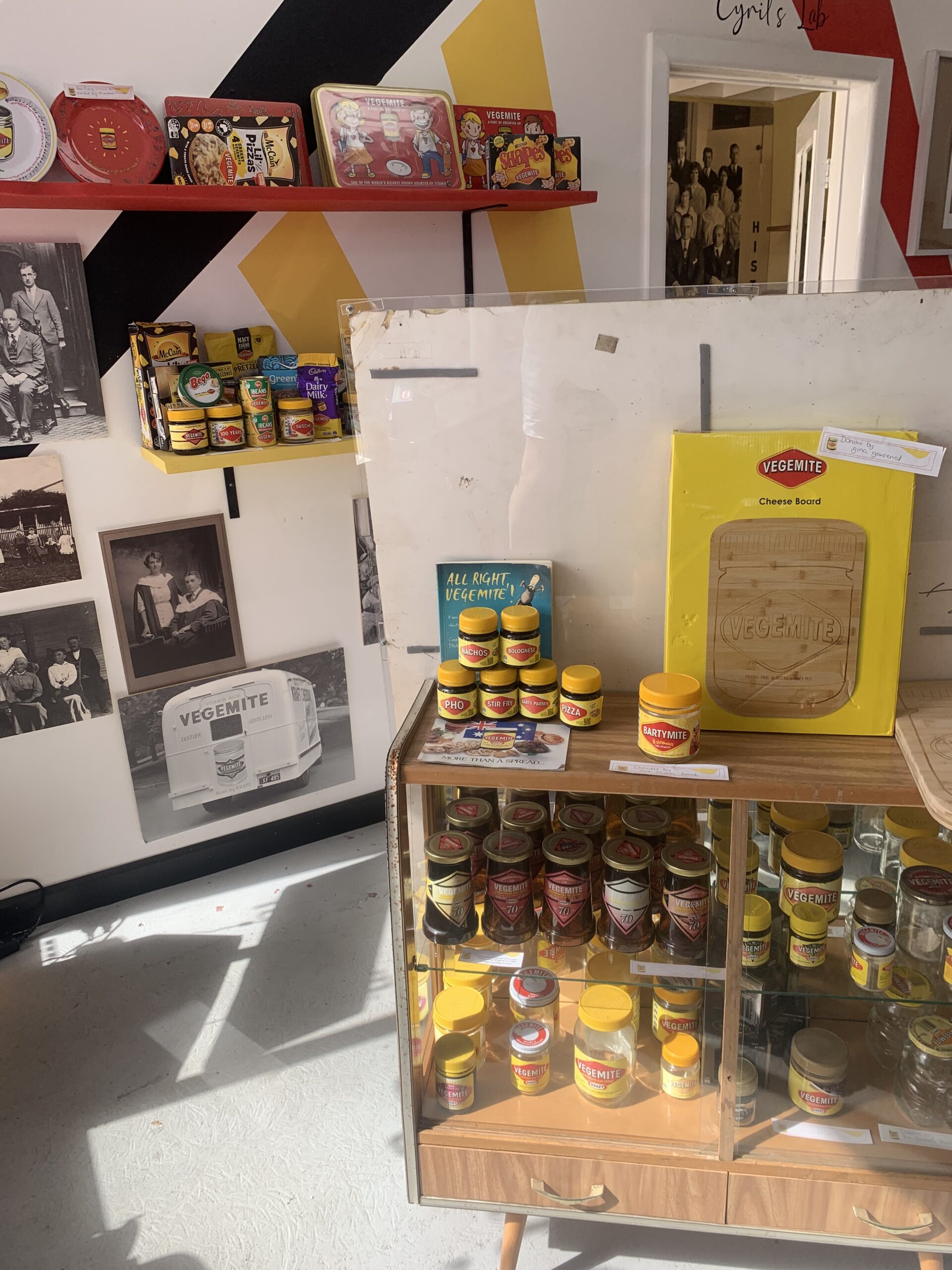
The yellow-labeled yeast spread, so famous, it has it’s own museum in Beaufort, Victoria, had it’s defence escalated to the Australian Prime Minister, who, after brief communication on social media with his Canadian equivalent, and likely much more official discussion from each nations respective trade ministries, an agreement was made and Vegemite was back on the shelves!

Cyril Callister Museum
Photo: Joseph S
Cyril Callister Museum
Photo: Joseph S
Cyril Callister Museum
Photo: Joseph S


Our visit to Found Coffee

We arrived on a busy Saturday morning to Found Coffee’s Bellwoods location, a beautiful suburb befitting this lovely coffee shop. Before even getting through the doors a gumball-turned-dog-treat machine was keenly serving the four legged members of the community. As we got up the steps we realised we certainly weren’t the only people out for a mid-morning Saturday cuppa, who would’ve thought? The kind and professional staff moved through the line quickly and in only a matter of a couple of minutes, we were at the front of the queue.

Found Coffee is special for not only it’s staple beverages and it’s famous Vegemite, but also for a wide range of seasonal drinks to keep every visit unique. We ordered the Banana Bread Latte, Lavendar Sugar latte, and Vanilla Almond Tea Latte. If a flat white is more your speed, they’ve got you covered. The shop offers a range of alternative milks for our dairy-free friends.

After sitting down we got to trying our delicious drinks and soaking up the atmosphere. The shop is well decorated. There are a few hints of yellow hiding in some corners, signalling the presence of our favourite Aussie spread, and it was just full enough to feel lively, but not crowded.

I tried all of the drinks, but speaking on my own order, the Vanilla Almond Tea Latte, I already knew I was going to be a fan of this one. Rooibos is one of my favourite teas, and it pairs so nicely with a sweet flavour like vanilla. Almond milk was a great addition to the already present Almond in the drink. Overall the drink had just enough sweetness and flavour going on to be an exciting, worthwhile seasonal beverage, without the over-the-top sugar mountain that is usually found in North America’s equivalents. Would I have one again? Absolutely.


Conclusion

Found Coffee truly is a taste of home away from home. Yes, even for a Kiwi! It’s no secret that due to our smaller populations, New Zealand and Australian-owned businesses are far and few between outside of our homelands.

An affordable coffee shop with great quality beverages. Whether you’re in the big city, or driving through Guelph, add Found Coffee to your list of places to try next.

Toronto probably won’t ever get a State of Origin game, probably won’t ever see the Bledisloe Cup, and won’t be a surprise entry into the great Pavlova debate, but it’s got Vegemite!

Article by Joseph Simpson, 29th March 2026
Want to know more? Reach out to Joseph via our Facebook and Instagram channels.
Read More about Vegemite for sale in Toronto? We tried this famous Aussie coffee shop in Canada
Posted By Joseph Simpson Posted on March 29, 2026
Posted inGuides Home News Ontario Toronto

Public Transport in Toronto: A Guide

After departing Aotearoa on an intrepid twenty-hour journey toward Ontario, figuring out public transport at the end of it certainly isn’t an undertaking for everyone. Some of you might be lucky enough to have a ride waiting at Pearson Airport, some might be considering forking over the small fortune for an Uber or taxi, and yes, that small fortune is considerably larger than what you are used to paying out of Auckland or Wellington airport. Or, some more clued on individuals might have purchased a Union-Pearson express ticket before they even landed! 

Regardless of what type of traveller you are, and whether you have yet to arrive, are a new addition, or a true Canadian “hoser,” the below guide will make you an expert on public transport in Toronto, the Greater Toronto Area (GTA), Ottawa, and Hamilton.

PRESTO

A PRESTO card is your key to getting around much of Ontario on public transport.

The cards are available for purchase at all Shoppers Drug Marts in the GTA, GO Transit & UP Express stations, and TTC stations. They are only $4 CAD (with a minimum load required), and work immediately after purchase.  

PRESTO cards provide discounted fares on almost all services and allow you to conveniently tap on and off where you would usually have to buy an advance ticket for the best rate, such as the GO Trains or the UP Express. There are usually further discounts offered by some municipalities and services for students, children, seniors, Canadian veterans, and more.

Just like your Auckland Transport card, Bee, or Snapper, these are physical cards. However, if you’d prefer not to have a physical card, you can swap your card to be digital, loaded onto your Apple Wallet or other phone wallet service.* **
*You can NOT have both a physical and a digital card, changing to digital deactivates your physical card.
** PRESTO cardholders travelling to Ottawa should NOT change their card to a digital card as OC Transpo does not accept digital PRESTO cards.

PRESTO Cards work on any public transport service in the cities of Toronto, the wider GTA, Hamilton, and Ottawa. The cards also work on GO Transit, which connects Toronto to several smaller Ontario cities. It’s important to note that PRESTO is not provincial-wide (yet, anyway). So those looking to travel to the likes of Kitchener-Waterloo, Sudbury, Kingston, St. Catharines, and so on, will need to conduct further research.  

Bonus, PRESTO cardholders also get discounts and perks at some attractions around Ontario. Click this link to see what discounts are currently on offer!

Don’t have a PRESTO yet? Every service mentioned in this guide allows you to tap most credit and debit cards, Wise and Revolut cards. Some international debit cards may not work, but in our experience, cards issued by New Zealand banks work just fine. 

In some cases cash and paper or digital tickets can also be purchased, such as the Union-Pearson Express. 

Toronto Transit Commission (TTC)

A TTC Streetcar
The TTC Subway

Finch, Vaughan, Union. These are names you’ll be hearing several times upon arriving in Toronto. The infamous TTC is known for lengthy construction times, delayed departures and a subway that has surprisingly lost more stops than gained in the last two decades. Yet it is the apparatus that keeps two of the six million strong city moving. The TTC is responsible for Toronto’s subway system, buses, and street cars. Below is a bit of insight on each of them.

The Toronto Subway’s ability to bypass traffic makes it one of the fastest and best methods of transportation in the city. Missed your train? You won’t be waiting much longer than five minutes for the next one. The biggest rapid-transport system in Canada (although Montreal is catching up!), this will be many people’s go-to from the work commute, to shopping, sports games, concerts and connecting transit. TTC subway entrances can be identified by their iconic red and white TTC logo, or by the coloured circles (typically yellow or green signifying the line they are on) with the stop’s name.

While the street cars are certainly better than the novelties in Auckland and Christchurch, they are in our experience, not to be relied on for punctuality, and don’t hold a candle to the tramways of San Francisco, Melbourne or much of Europe. They are a great way to see downtown Toronto and provide a smooth and comfortable journey. For job interviews, stick to the bus.

The buses of the TTC are relatively reliable and connect most of the space left in between the subway and street cars. They are naturally subject to traffic so be sure to plan ahead and give yourself a bit of extra time in case of delays. A note that outside of Toronto proper, local municipalities operate their own buses, not the TTC. They all accept PRESTO, but information  as fares and reliability will vary from Burlington to Oshawa. 

All TTC transport is tag on when boarding, you do not need to tag off when disembarking.

GO Transit

GO Transit is the best option for mid-ranged travelling around the GTA. If you don’t have a car, it will be the key to getting to Niagara Falls, and surrounding cities. Easily identified by their iconic green branding, they are a popular choice for out of town commuters and visitors alike. They are the Te Huia or Capital Connection equivalents.

GO Trains are what run on Toronto’s heavy rail. The main hub is Union station, which converges with the TTC’s subway. There are seven main lines which operate with varying frequency, usually on the half-hour or the hour, but check ahead and plan your visit in advance to avoid having to wait around unnecessarily. The Lakeshore West line is the train line that takes you to Niagara Falls.

Just like the train, GO Busses connect Toronto to the wider region, but they can travel to neighbouring cities that do not have the same rail infrastructure, and are in some cases, even quicker than the train! Once again, this is subject to the traffic on the day. GO Busses are incredibly useful for those in the outer region of the GTA, as they are the best public transport option for reaching Pearson Airport.

GO Transit offers weekend passes which give unlimited travel on one weekend day (and public holidays) for $10. These must be bought online and are a great way to save some money on your weekend excursions. 

GO Transit is one of the only services where you have to tag on, and off.

Union-Pearson (UP) Express

The Union-Pearson Express is the conduit between Toronto’s busiest train station and her busiest airport. This express connection is incredibly fast and efficient.

As mentioned earlier, the UP express can use a PRESTO card, most debit and credit cards, and tickets can be bought online, or in person. Fill your boots!

The UP Express only goes to-and-from Pearson Airport’s Terminal 1, so for flights arriving and departing from Terminal 3 will need to use the free Toronto Pearson International Airport Terminal Link to head to Terminal 1.

The UP Express is one of the only services where you have to tag on, and off.

VIA Rail

VIA is the long-range rail system that services both the whole province, and all of Canada. For those cities in Ontario far away from Toronto such as Windsor, Sudbury, and Ottawa. This is not a tag-on-tag-off service, and tickets must be purchased in advance.

The VIA rail is incredibly efficient, and has a low risk of cancellation, so is one of the safest options for inter-provincial travel, though it is often more expensive than private bus companies.

Booking well in advance is the best way to keep the price as low as possible. There are also discounts for certain groups such as students at certain universities, and CAA members. Those of you under 25, keep an eye on the “Canada Strong Pass” which has been providing periodic VIA rail discounts throughout 2025 and 2026. 

Hamilton Street Railway (HSR) & Ottawa’s OC Transpo

Ottawa’s O-Line Train
A Hamilton Street Railway (HSR) Bus

In addition to Toronto, PRESTO can also be used for public transport in Hamilton and Ottawa.

Hamilton’s HSR has a very reliable bus service. The city’s significantly smaller population means traffic has minimal impact on the busses. Most routes connect at the Frank A. Cooke terminal near the Hamilton GO station, allowing for easy connection to Toronto.

In 2025, a bus was stolen and the considerate crook still took the time to made all the stops along the route! No matter who’s behind the wheel, you’ll be in safe hands.

In addition to the busses, the Hamilton LRT has been “coming” for over fifteen years, so, expect to see ground broken in 2080 at this stage. 

Ottawa’s OC Transpo does do one better than Hamilton, with the O train line connecting the East and West of the city, and the airport, for an affordable price. Heeded North or South? That’s too bad, you’ll have to find another way to get around

The city does have a relatively reliable bus service, especially downtown and around the university, with mixed reviews in the outer parts of the city. 

Despite being less than a fifth of the size of Toronto, Ottawa’s public transport is certainly lagging behind other cities in Canda, and is one of the most expensive to use in Ontario. As of writing this, it’s a full dollar more than the HSR and TTC on one-way trips.

Toronto Island Ferries

Be cautious of water taxis in the harbour

Lastly, Toronto Island Ferries, unlike the rest of Toronto’s transport, are run directly by the city. They are the only public transport connection between the island and the mainland.

A round trip will set you back just shy of $10 CAD as of 2026, with a few discounts for seniors and children. This makes it one of the more expensive options on this list, but be wary of water taxis. They do have the advantage of convenience, but will sting you dollars well into the double digits!

Tickets can be purchased online or at the terminal, they run with varying frequency throughout the seasons, usually on the half-hour, forty-five minute, or hour marks.

If you are flying in and out of Toronto’s Billy Bishop Airport (YTZ), do not take the ferry. Instead, there is an underwater pedestrian tunnel you can take for free!


And that’s a guide on Toronto’s public transport, by kiwis, for kiwis. Not comprehensive enough for your liking? Don’t worry, we’ve got you. Below is a link to the landing page of every service mentioned above for you to keep on learning to make you a Toronto public transport maestro.

PRESTO
Toronto Transit Commission (TTC)
GO Transit
VIA Rail
UP Express
Hamilton Street Railway (HSR)
OC Transpo
Toronto Island Ferry

Article by Joseph Simpson, 23rd March 2026
Want to know more? Reach out to Joseph via our Facebook and Instagram channels.

Read More about Public Transport in Toronto: A Guide
Posted By Joseph Simpson Posted on March 23, 2026
Posted inNews Sports

All Whites fall short of tournament glory against Ukraine

There was hope in the eyes amongst the fans of the All Whites (ranked 86th) for a moment of glory after beating reigning Africa Cup Champions, Ivory Coast (Ranked 41st) one goal to nil.

Just two hours beforehand, Canada had won an upset of their own against competition favourites Ukraine, in a four-two result. There was a chance that the Kiwi Men could win their first international tournament in 26 years, outside of their ever-dominant OFC Nations cup performances.

Two matches would need to fall into place, the Ivory Coast would need to hold off the Canadians, and the New Zealanders needed to pull off an even bigger upset, A victory over Ukraine.

Yesterdays match was the first ever meeting between the two nations in men’s football. In fact, this whole tournament had been firsts, including their game against the Ivory Coast. Perhaps a slight edge for the men wearing the silver fern, given these European and African powerhouses were unlikely to have had diligently reserarched their opposition ranked so far behind.

New Zealand’s veterans goal scorers Chris Wood and Kosta Barborouses found themselves on the bench for the most insurmountable matchup in the Canadian Shield. Young Wellington Phoenix turned Plymouth Argyle & Mansfield Town striker Ben Waine was given the start. Perhaps New Zealand football saw something in the coaching ability of Plymouth’s Wayne Rooney the rest of the UK and all their professional analysts and scouts couldnt see.

Ukraine’s squad reflected confidence with third choice keeper Andriy Lunin in the net, though that might have happened against any side given Anatoliy Trubin’s four goal capitulation against the Canadians just days prior. The Ukrainian attack was a quiet mix of local league players, while on-form striker, Olympiaco’s Roman Yaremchuk also stood ready in reserve.

The player to watch was rising star and captain Illia Zabarnyi of the Premier League’s Bournemouth. The most recent encounter betwen the young defender and New Zealand’s Nottingham Forest Star Chris Wood resulted in a 5-0 capitulation in favour of the Ukrainian.

Perhaps the only thing going strongly in New Zealand’s favour was the previous match record, with huge results against the Pacifc in their OFC world cup qualifiers, and the momentum of their triumph over the Ivory coast, meanwhile, Ukraine had been battered by Belgium in their last match on European soil before limping through their match against Canada.

The GO Trains arrived, street vendors sold flags and hats on the corners of Exhibition Station. Thousands of fans poured into the stadium, perdominantly wearing blue and yellow. The stage was set for a clash to remember.

As the game kicked off, the already strong Ukrainian diaspora in Ontario, further reinforced by a recent influx of refugees, bellowed out chants like a church chior doing a one-off metal concert. A mix of well-rehearsed expatriots, alongside confused Canadian-born Ukrainians, made for a noise that might have sounded melodic had there not been such a large contingent of locals without knowledge of their mother tounge in the crowd.

The first twenty minutes of the game were defined by the defensive work of the All Whites, despite only holding a fraction of the possession, the few moments with the ball saw them roar up the field straight into attacking position, unfortunately unable to link up with Ben Waine’s boot. Sarpreet Singh made a strong argument for a return to Bayern Munich with excellent distributing and was the key link between getting the ball from the New Zealand defence upfield.

While New Zealand spent most of the first half shooting deperately, and often off target, Ukraine’s Yehor Nazaryna and Oleksiy Hutsulyak were considerably more accurate, only narrowly being stopped by the calm and collected Max Crocombe, at Goalkeeper for New Zealand.

The party of New Zealand supporters, numbering about thirty in the 28,000 seater stadium, responded to the Ukrainian onslaught with two impassioned yet also fleeting chants of Tutira Mai throughout the full course of the game. The only thing not suffocating the fans was the fortunate thousands of empty Canadian-red seats dotted throughout the patches of Ukrainians.

Starting the second half the Ukrainians came out firing with another run of accurate shots on goal. At this point, the number of shots had been noticeable swinging in favour of the Eastern Europeans, and their fans were completely behind them.

“Who’s not jumping is Russian” was one of the many chants that would come up, and the confused New Zealanders, alerted by haphazard translation from one of the Kiwi supporters, saught Ukrainian insight on the translation and got a startling explanation.

While the separation of sport and politics is seen as noble and important to many, the New Zealanders were, in fact, not Russians, and that was enough to get them to jump along to the Ukrainian chants. The only red white and blue out in the stands that day was that of the Union Jack and the Southern Cross!

The first goal of the night was scored by Ukraine’s Oleksiy Hutsulyak 54 minutes in, beautifully assited by a monstrous diagonal crossfield kick from captian Illia Zabarnyi to Oleksandr Pikhalyonok, who crossed Hutsalyak straight into the box and the lighting quick, yet simple shot, breezed into the net.

The All Whites had not faught tooth-and-nail only to collapse now, and redemption was quickly achieved through Samoan-Serbian Marko Stamenić, as he used his forehead to nudge in the well executed equaliser for the all whites, a confident Ukraine crowd had a moment to waver.

Unfortunately for the Kiwis, Arsenal’s Oleksandr Zinchenko put the game away, with a cross that looked like a textbook copy to their first goal. If it ain’t broke, don’t fix it. For the last fifteen minutes, New Zealand hunted for the equaliser, and even got a good attempt in, but as the sea of red, white, and the maple leaf filled the empty seats of the stadium, resignation was the only emotion on the faces of New Zealand’s fans, both locals from Kia Ora Canada, and those from the Flying Kiwis that made the intrepid trip to the 6ix.

While tournament glory fell away for the New Zealanders, The Ivory Coast had managed to beat the Canadians on penalty goals. leaving the Kiwis with the consulation of second place. In a tournament where we were ranked over forty places behind the nearest ranked team, it’s not a result to complain about.



Match Information

Canadian Shield Tournament
New Zealand (1) v Ukraine (2), Toronto, 10th June 5.00pm
Goalscorers: Oleksiy Hutsuliak 54′, Oleksandr Zinchenko 75′ UKR, Marko Stamenic 59′ NZL

Read More about All Whites fall short of tournament glory against Ukraine
Posted By Joseph Simpson Posted on June 11, 2025

Sign up for our Newsletter

Sign up to our newsletter for the latest updates:

Previous News

  • September 2026
  • August 2026
  • June 2026
  • May 2026
  • April 2026
  • March 2026
  • January 2026
  • December 2025
  • November 2025
  • June 2025
  • August 2024
  • July 2024
  • September 2023
  • April 2023
  • January 2023
  • December 2022
  • November 2022
  • June 2022
  • January 2022
  • April 2021
  • January 2021
  • January 2020

Recent Posts

  • All Blacks fall short in Greatest Rivalry equaliser
  • Six60 Rock Pier Six Pavilion
  • Niagara Falls: A Guide
  • Ryan Fox Chases History at the 2026 RBC Canadian Open
  • New Zealand Pre-Match Parties – Vancouver

Latest Business Directory Listings

  • Far Ocean Canada
© Kia Ora Canada Toronto 2020
  • Home
  • About Kia Ora Canada – Toronto
  • Newcomers
  • Contact Us